
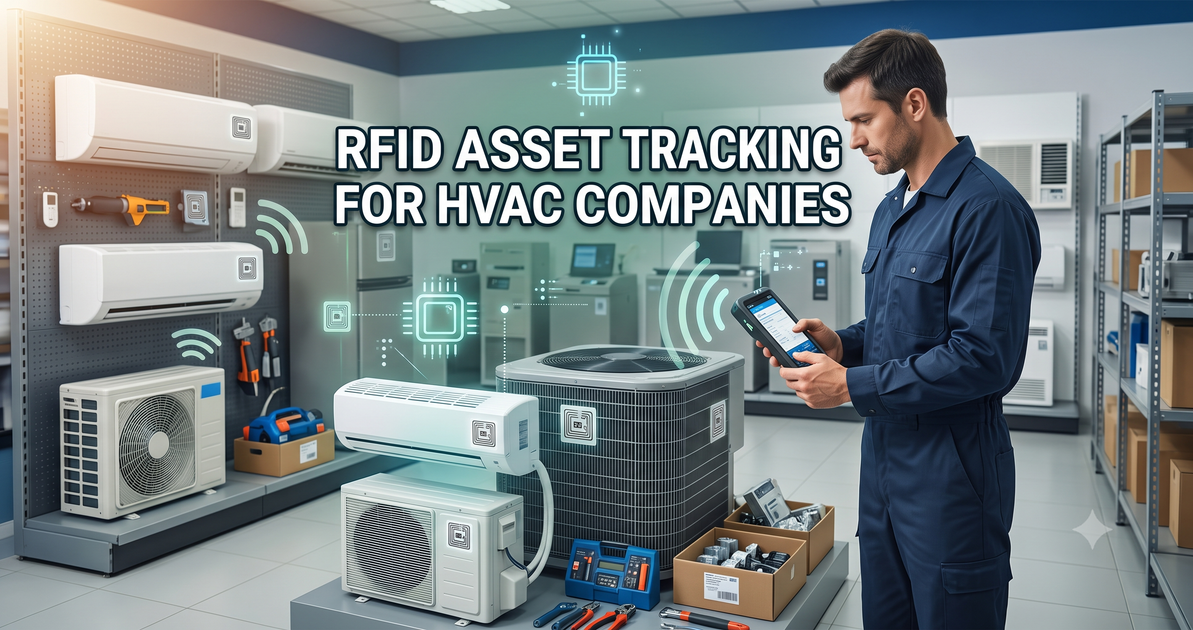
RFID Asset Tracking for HVAC Companies
HVAC companies rely on a wide range of tools, vehicles, and spare parts to deliver timely service. Managing these assets efficiently is critical for reducing costs, meeting compliance requirements, and ensuring customer satisfaction.
Traditional tracking methods often lead to misplaced tools, delayed projects, and inaccurate records. RFID technology offers a modern solution by automating asset tracking, improving visibility, and reducing errors.
Understanding HVAC Asset Management
HVAC businesses manage diverse assets such as:
- Tools and instruments used by technicians
- Equipment like compressors, chillers, and air handlers
- Service vehicles and mobile units
- Spare parts and consumables stored in warehouses
- IT asset management for HVAC companies' corporate offices.
Common challenges include misplaced tools, delays in service due to missing equipment, and inventory inaccuracies. Manual logs or barcode systems often fail to provide real-time visibility, making it difficult to track assets across multiple job sites.
What is RFID technology?
RFID is a smart tracking system that uses tags, readers, and software to monitor assets automatically. It eliminates manual errors, speeds up audits, and provides real-time visibility across HVAC operations.
RFID Tags
RFID tags are small chips attached to assets that store unique identification data. They are durable, easy to apply, and allow companies to track tools, vehicles, and spare parts without manual logging or barcode scanning.
RFID Readers
RFID readers capture tag information without requiring line-of-sight scanning. They can be fixed at entry points or handheld for mobile use, making it easier to monitor assets across warehouses, vehicles, and job sites in real time.
Software Systems
Software platforms integrate RFID data into dashboards and reports, giving managers instant visibility of assets. Solutions like TagMatiks RFID Software provide user-friendly dashboards, analytics, and compliance tools, helping HVAC companies streamline operations and make smarter, data-driven decisions.
Type of RFID Tags and Labels:
Passive RFID: Passive RFID tags do not have batteries. They are activated by signals from readers and are cost-effective for tracking large volumes of assets, making them ideal for tools and spare parts in HVAC businesses.
RFID vs Barcodes
Unlike barcodes, RFID allows bulk scanning and does not require direct visibility. This enables faster audits, reduces manual errors, and provides real-time asset visibility, making it a more efficient solution for HVAC companies.
Benefits of RFID for HVAC Companies
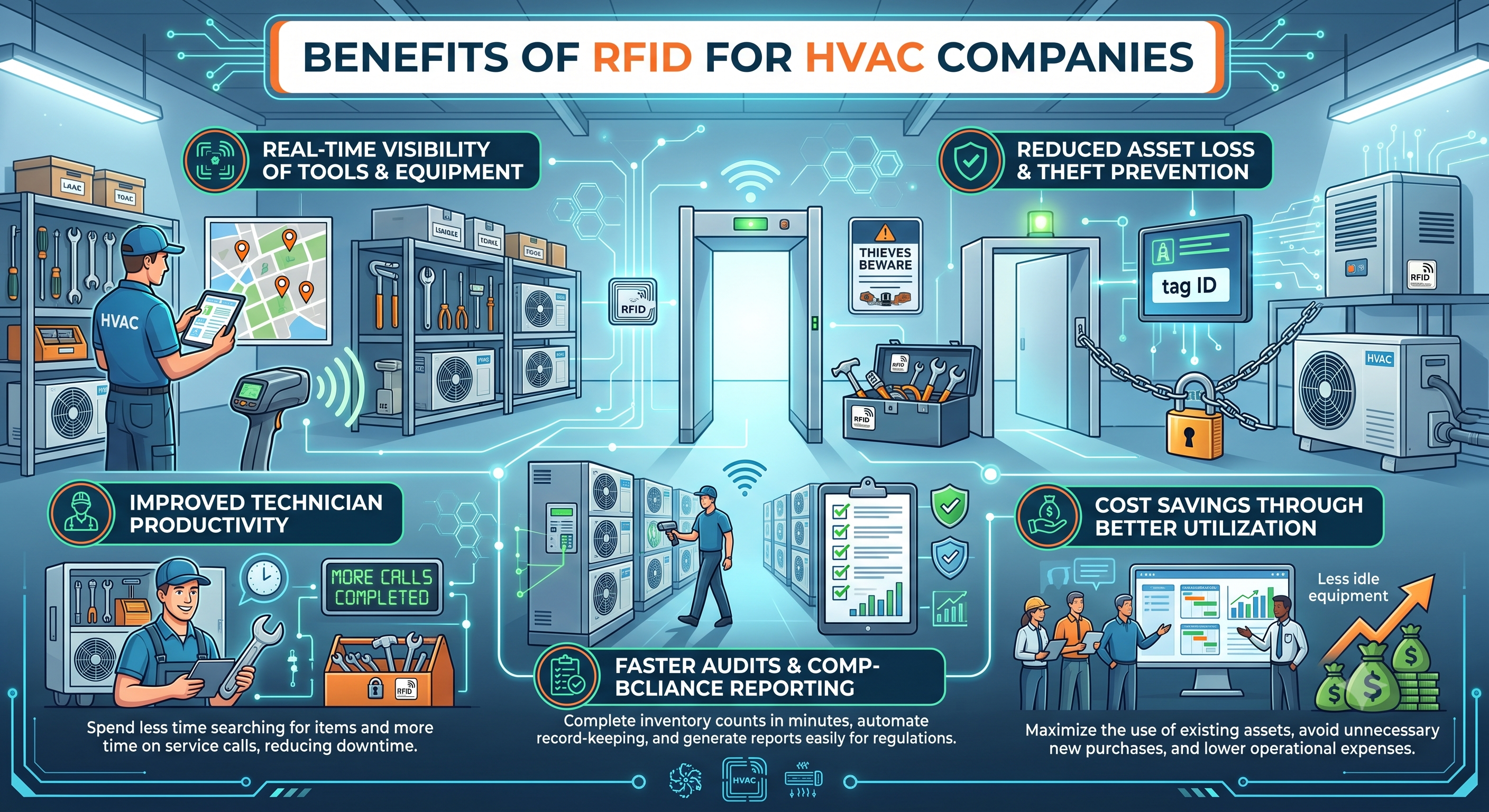
Real-time visibility of tools and equipment
RFID provides instant updates on the location and status of tools and equipment. Technicians and managers can quickly check availability across job sites, reducing delays and ensuring assets are always where they are needed.
Reduced asset loss and theft prevention
By attaching RFID tags to valuable tools and equipment, companies can monitor movement and receive alerts if items leave designated areas. This reduces theft, prevents misplacement, and ensures accountability for all assets.
Faster audits and compliance reporting
RFID enables bulk scanning of hundreds of items in seconds, making audits quicker and more accurate. Compliance reports can be generated automatically, saving time and reducing manual errors during inspections or regulatory checks.
Improved technician productivity
Technicians spend less time searching for tools or waiting for replacements. RFID ensures the right equipment is available when needed, allowing them to focus on completing jobs faster and improving customer satisfaction.
Cost savings through better utilization
With clear visibility into asset usage, companies avoid unnecessary purchases and extend the life of existing tools. Reduced downtime and optimized resource allocation lead to significant cost savings over time.
Use Cases of RFID in the HVAC Industry
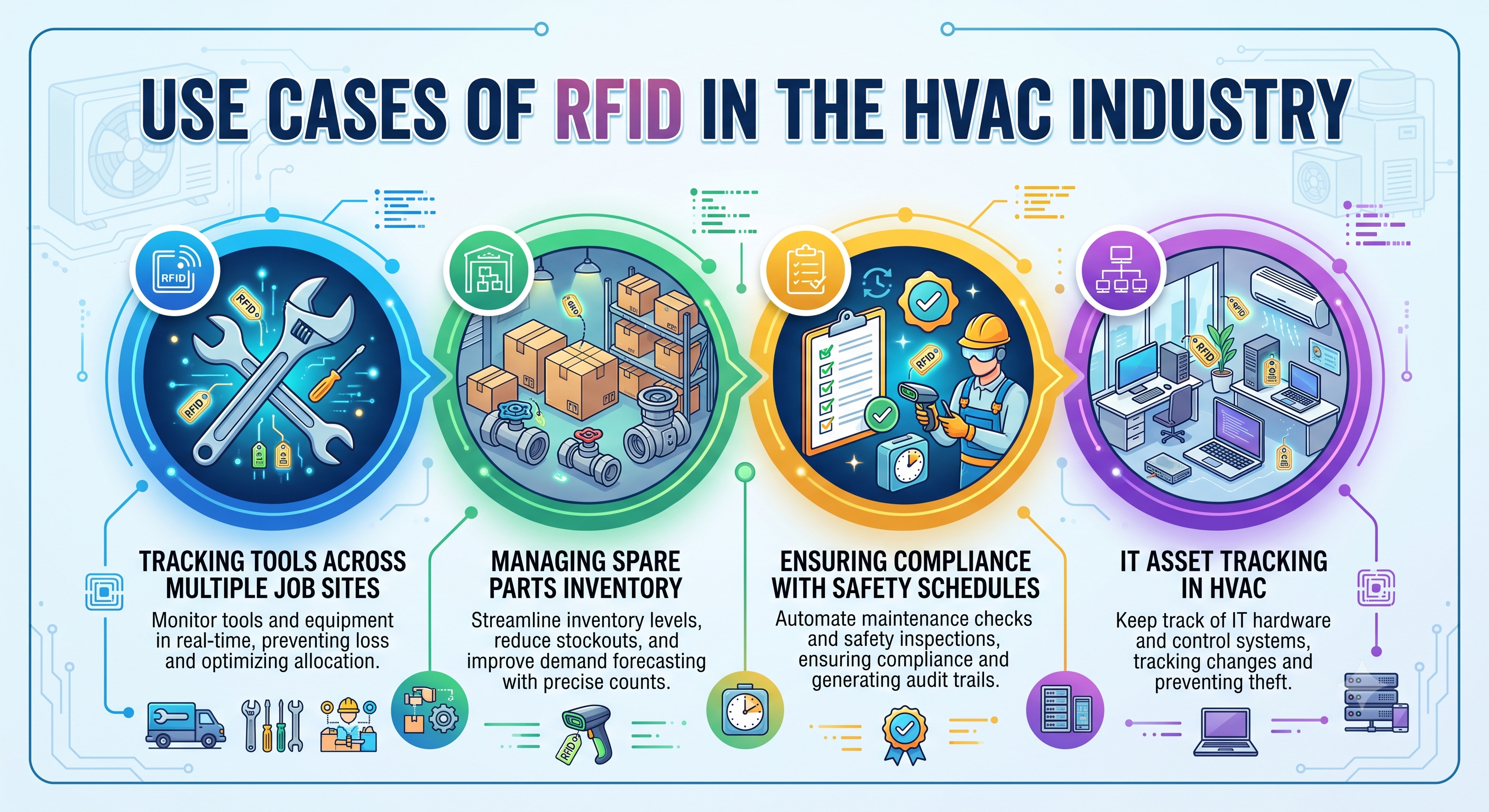
Tracking tools across multiple job sites
RFID helps HVAC companies track tools across different job sites. Technicians can quickly locate equipment, reducing misplacement and saving time. This ensures projects run smoothly without delays caused by missing or misplaced tools.
Managing spare parts inventory
Warehouses often struggle with inaccurate stock levels. RFID provides real-time visibility of spare parts, ensuring accurate inventory counts. This prevents shortages, avoids overstocking, and helps HVAC companies maintain efficient supply chain operations.
Ensuring compliance with safety schedules
RFID systems can track maintenance schedules and safety checks for HVAC equipment. Automated alerts remind teams of upcoming inspections, helping companies stay compliant with regulations and ensuring equipment remains safe and reliable.
IT Asset Tracking in HVAC
Beyond physical tools, HVAC companies also rely on IT assets such as laptops, printers, and mobile devices. RFID can help track these items to ensure technicians have the digital resources they need for service calls.
Implementation Process for RFID in HVAC Companies
Step 1: Asset Identification and Tagging
Begin by identifying all critical HVAC assets such as tools, vehicles, and spare parts. Attach durable RFID tags securely to each item, ensuring they withstand field conditions. This step creates a foundation for accurate tracking and prevents misplacement across multiple job sites.
Step 2: Deploy RFID Readers
Install RFID readers strategically at warehouses, vehicles, and job sites. Fixed readers should be placed at entry and exit points, while handheld readers support mobile tracking. Proper configuration ensures optimal coverage, enabling seamless data capture and real-time visibility of asset movement.
Step 3: Integrate with ERP/CMMS Systems
Connect RFID data with existing ERP or CMMS platforms to centralize asset information. Integration enables real-time dashboards, automated reporting, and compliance tracking. This ensures managers have a single source of truth for asset usage, inventory levels, and service documentation.
Step 4: Train Staff for Adoption
Provide hands-on training sessions for technicians and managers to ensure smooth adoption. Create simple usage guidelines and demonstrate productivity benefits. Staff confidence in using RFID systems reduces errors, encourages consistent practices, and ensures long-term success of the implementation.
Step 5: Continuous Monitoring and Optimization
Regularly monitor RFID system performance to maintain accuracy. Adjust reader placement if coverage gaps appear and expand tagging to new assets as operations grow. Continuous optimization ensures the system evolves with business needs, delivering maximum efficiency and ROI.
TagMatiks AT is an RFID-based asset tracking solution
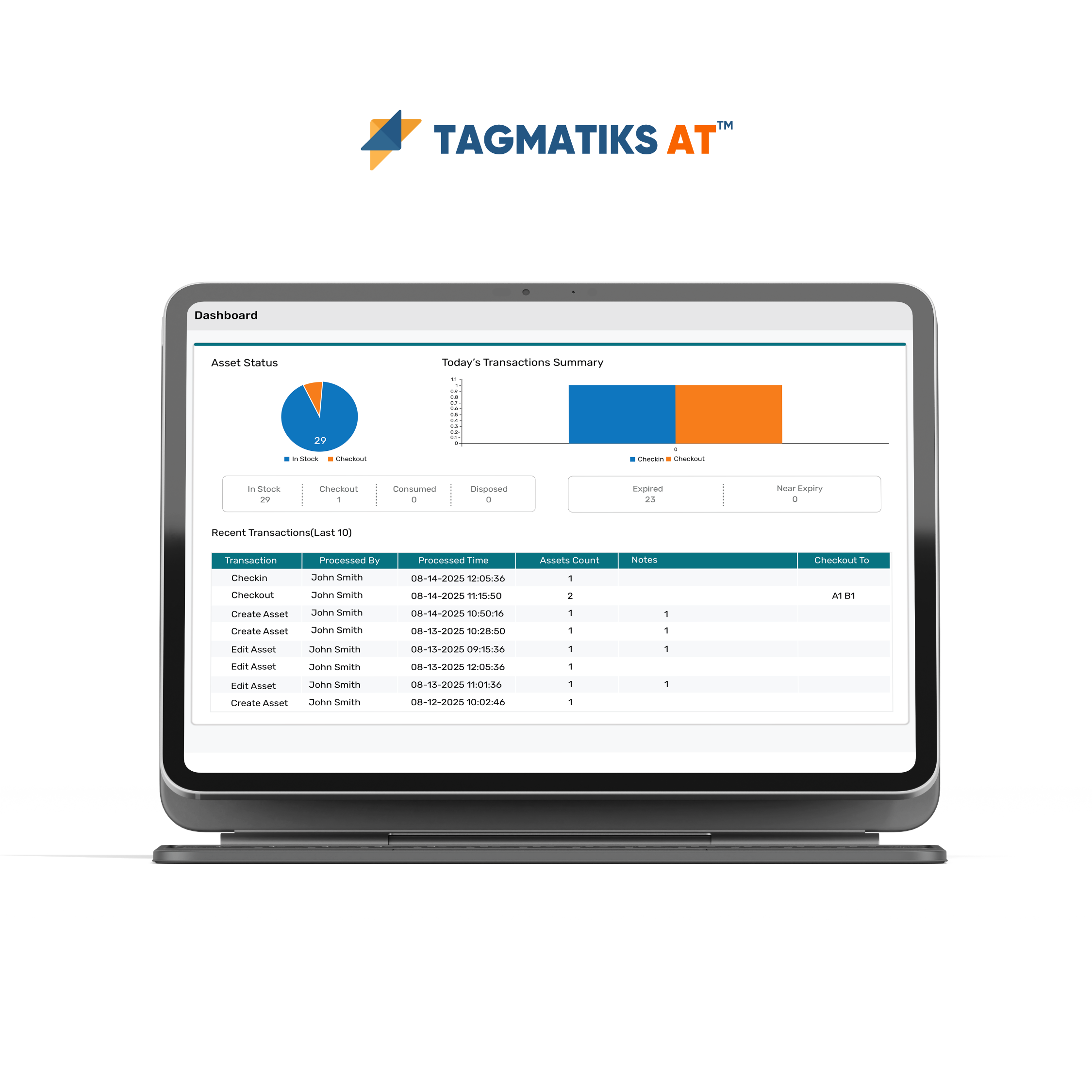
TagMatiks AT is a powerful RFID-based asset tracking solution that can transform how HVAC companies manage equipment, maintenance, and service workflows. By digitizing asset visibility and automating tracking, HVAC firms reduce downtime, improve technician efficiency, and ensure compliance with preventive maintenance schedules.
Why HVAC Companies Need TagMatiks AT
- Asset visibility: HVAC firms manage hundreds of assets — chillers, air handlers, compressors, ducts, and tools. TagMatiks AT provides real-time location and lifecycle tracking.
- Maintenance scheduling: Built-in modules allow preventive maintenance reminders, repair logs, and service history tracking.
- Technician efficiency: RFID tags eliminate manual entry errors and reduce time wasted searching for equipment details.
- Compliance & audits: Automated reconciliation ensures HVAC companies meet safety and regulatory standards.
Key Features for HVAC Industry
- RFID & Barcode support: Enables quick identification of HVAC units, tools, and consumables.
- Cloud dashboards: Managers can view KPIs like downtime, repair costs, and asset utilization.
- Automated workflows: Check-in/check-out of tools, asset transfers between sites, and disposal tracking.
- Repair history: Complete logs of past issues, costs, and technician notes.
- Integration: Connects with ERP or CMMS systems for seamless operations.
Challenges in RFID Adoption
While RFID adoption in HVAC companies requires investment, the benefits outweigh the hurdles. Long-term savings offset initial costs for tags, readers, and integration. Signal interference can be minimized with proper setup, and integration with legacy systems is achievable through customization. With effective staff training and change management, companies can unlock efficiency and maximize ROI.
Conclusion
RFID is transforming asset management for HVAC companies by reducing losses, improving efficiency, and enhancing customer satisfaction. With real-time visibility and automation, businesses can achieve better ROI and streamline operations. For HVAC companies aiming to stay competitive, adopting RFID is not just an option—it’s a necessity.
Recent Posts
-
5 Tag Placement Errors Ruining RFID Accuracy
Introduction Radio Frequency Identification has become a backbone of modern inventory management, re …Sep 8th 2026 -

RFID Asset Tracking for HVAC Companies
HVAC companies rely on a wide range of tools, vehicles, and spare parts to deliver timely service. M …Aug 25th 2026 -

Fix Inventory Inaccuracy with RFID Inventory Tracking Software
Introduction Inventory inaccuracy is one of the biggest challenges businesses face today. Manual err …Aug 12th 2026