
5 Tag Placement Errors Ruining RFID Accuracy
Introduction
Radio Frequency Identification has become a backbone of modern inventory management, retail operations, and manufacturing workflows. Its ability to provide real-time visibility into assets and products makes it indispensable. However, RFID accuracy depends heavily on how tags are placed. Poor placement can lead to missed reads, ghost reads, and unreliable data, undermining the entire system.
This blog uncovers the five most damaging tag placement errors and explains how businesses can avoid them to ensure consistent performance and better ROI.
What is RFID Tag Placement?
RFID tag placement refers to the positioning of tags on products, assets, or packaging so that they can be read accurately by RFID readers. The way a tag is placed directly affects signal strength, readability, and overall system performance. Even if you use high-quality tags and advanced readers, poor placement can lead to weak signals or missed scans. That’s why placement is just as important as choosing the right tag type or configuring the reader correctly.
Why Tag Placement Matters
Correct RFID tag placement is critical because poor positioning can cause data gaps, inventory errors, and operational delays. When tags are placed properly, they ensure consistent scanning, faster audits, and reliable visibility across the supply chain. This accuracy translates into better efficiency and reduced costs. From a business perspective, good placement improves ROI by minimizing wasted time, avoiding costly rescans, and ensuring that RFID systems deliver the real-time insights they were designed to provide.
Error 1: Placing Tags on Metal Surfaces
Problem
Standard RFID tags often fail when placed directly on metal surfaces because radio signals bounce back or get absorbed. This reflection and interference weaken the tag’s ability to communicate with readers, making it difficult to capture accurate data during scanning operations in industrial or retail environments.
Impact
When tags are placed on metal, businesses face ghost reads, blocked signals, and reduced scanning range. These issues lead to unreliable data, missed inventory counts, and operational inefficiencies. Inconsistent reads can disrupt workflows, delay audits, and compromise the accuracy of asset tracking systems.
Fix
To overcome this challenge, companies should use anti-metal RFID tags or TagMatiks pre-printed/pre-encoded on-metal RFID labels designed with isolation layers that prevent signal distortion. Alternatively, tags can be mounted on non-metallic brackets or spacers. These solutions ensure stronger readability, reduce interference, and maintain consistent performance across different scanning environments.
Example
In automotive manufacturing plants, RFID tags placed directly on car frames often fail to scan due to metal interference. By switching to anti-metal tags or using specialized mounting brackets, businesses achieve reliable asset tracking, smoother production workflows, and improved visibility across the supply chain.
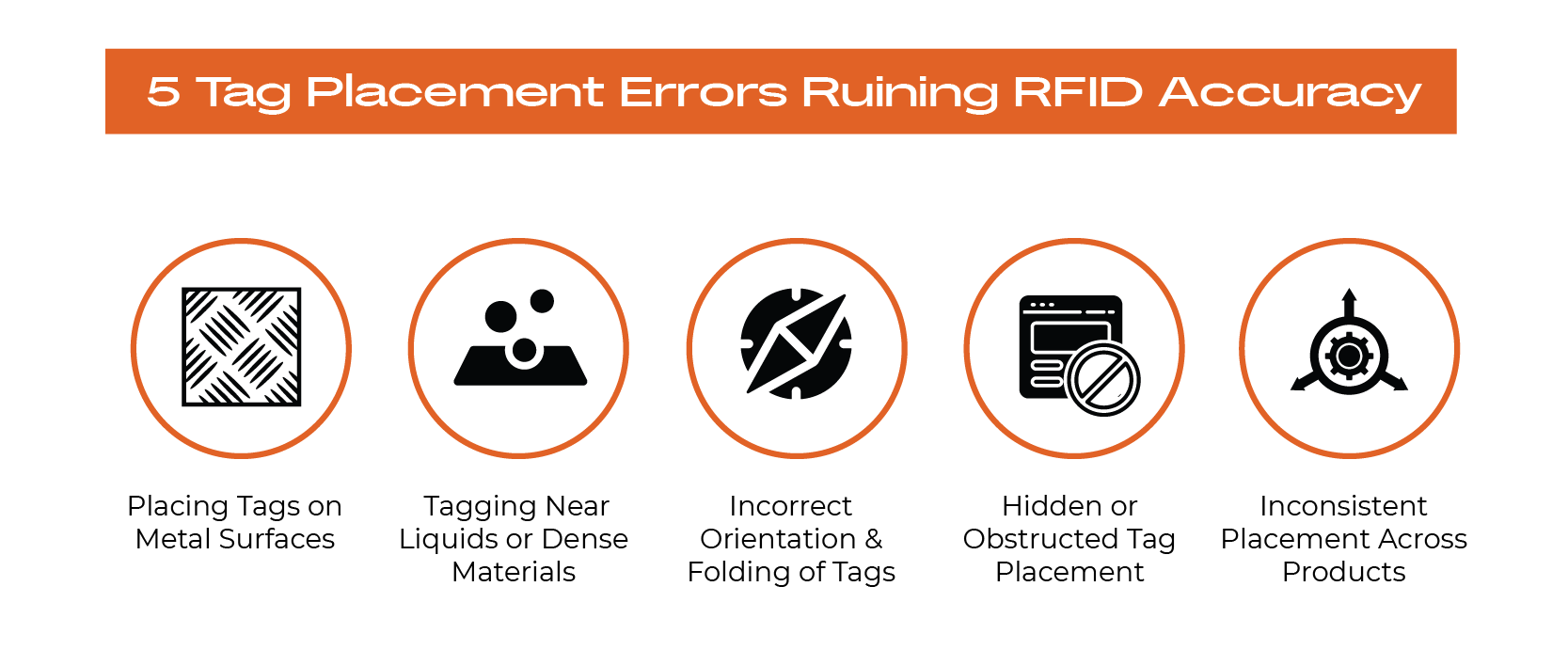
Error 2: Tagging Near Liquids or Dense Materials
Problem
Liquids can weaken or absorb UHF signals, and dense packaging may block antenna performance. The challenge arises when tags are placed in poor positions, such as directly behind liquid-filled areas, which reduces readability.
Impact
Incorrect placement around liquids or dense materials often leads to missed scans, slower reads, and unreliable inventory data. This is especially noticeable in beverage cases, chemical drums, or tightly packed cartons where signals struggle to pass through.
Fix
Instead of avoiding UHF tags, businesses should use TagMatiks Flag RFID tags or TagMatiks SALT tags optimized for liquids, or place tags in areas with less interference, such as bottle necks or flat, unobstructed surfaces. Testing placement in real-world conditions ensures consistent performance.
Example
Grocery retailers often use UHF tags on bottled water or milk. When tags are placed on the neck or cap area, readability improves significantly. Specialized UHF tag designs for liquids also help maintain accuracy during inventory checks and point-of-sale scanning.
Error 3: Incorrect Orientation & Folding of Tags
Problem
Tags placed at odd angles, folded, or hidden under packaging disrupt antenna alignment. This misalignment prevents RFID readers from properly detecting signals, reducing the efficiency of scanning and creating gaps in inventory visibility.
Impact
When orientation is incorrect, reader antennas cannot align with tag polarization, leading to blind spots. This results in inconsistent reads, missed items, and slower operations, which directly affects productivity and data accuracy in retail or warehouse environments.
Fix
The solution is to ensure tags are placed flat and oriented correctly. Avoid bending, folding, or covering antennas with labels or packaging. Proper placement improves readability, reduces blind spots, and ensures smoother scanning across different product categories.
Example
In apparel stores, tags folded inside garments often fail to scan consistently. By placing tags flat and outward-facing, retailers achieve smoother checkout processes, faster audits, and more reliable inventory tracking without interruptions or repeated scanning attempts.
Error 4: Hidden or Obstructed Tag Placement
Problem
When RFID tags are hidden under labels, inside boxes, or behind product parts, signals are blocked. This obstruction prevents readers from detecting the tag properly, reducing the efficiency of scanning and limiting visibility across operations.
Impact
Hidden or obstructed tags often cause inconsistent scanning and missed reads. This reduces inventory accuracy, slows audits, and creates operational delays. Businesses relying on real-time data may face disruptions in supply chain tracking and warehouse management.
Fix
To solve this, tags should be placed on visible and accessible surfaces with minimal obstructions. Ensuring clear placement allows RFID readers to capture signals consistently, improving accuracy and reducing the need for repeated scans or manual checks.
Example
In warehouses, pallets with tags hidden under shrink wrap often fail gate reads. By moving tags to exposed surfaces, companies achieve smoother scanning, faster processing, and more reliable tracking of goods during inbound and outbound logistics.
Error 5: Inconsistent Placement Across Products
Problem
When RFID tags are placed differently on similar items, such as one on the top and another on the bottom, readers struggle to detect them consistently. This inconsistency creates confusion and reduces the efficiency of scanning systems.
Impact
Inconsistent tag placement slows down audits and reduces detection accuracy. Readers must adjust repeatedly, leading to missed scans, longer processing times, and unreliable inventory data. This directly impacts productivity and customer experience in retail and warehouse operations.
Fix
The best solution is to standardize placement guidelines across all SKUs and ensure staff are properly trained. Consistency in tag positioning improves readability, speeds up audits, and ensures reliable performance across different product categories and environments.
Example
Retail stores often face checkout delays when tags are placed inconsistently on similar products. By adopting uniform placement standards, businesses achieve faster scanning, smoother customer transactions, and more accurate inventory tracking without unnecessary interruptions.
Best Practices for RFID Tag Placement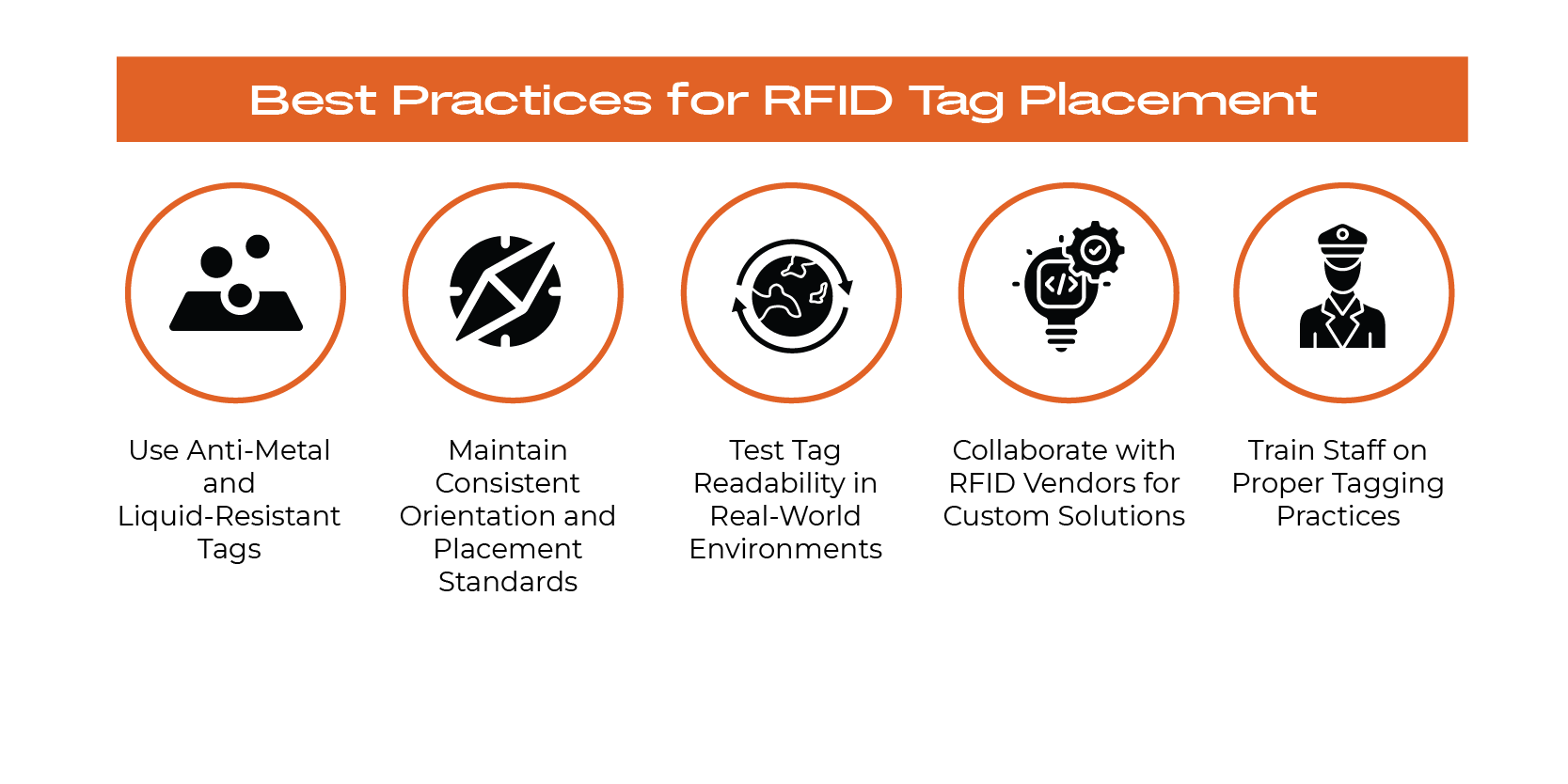 Use Anti-Metal and Liquid-Resistant Tags
RFID tags designed for metal or liquid environments prevent signal distortion and absorption. These specialized tags ensure reliable readability in challenging conditions, reducing ghost reads and missed scans across industries like automotive, chemical storage, and beverage retail.
Maintain Consistent Orientation and Placement Standards
Consistency in tag orientation and placement across products ensures smoother scanning. Standardized guidelines help staff avoid errors, improve detection accuracy, and reduce delays during audits or checkout, making RFID systems more efficient and dependable.
Test Tag Readability in Real-World Environments
Lab tests alone aren’t enough. Tags should be tested in actual operating environments such as warehouses, retail floors, or production lines. Real-world testing identifies blind spots, interference issues, and ensures RFID systems perform reliably under everyday conditions.
Collaborate with RFID Vendors for Custom Solutions
Working with RFID vendors allows businesses to access tailored solutions for unique product types or environments. Vendors can recommend specialized tags, placement strategies, and system adjustments that maximize performance and reduce costly implementation errors.
Train Staff on Proper Tagging Practices
Even the best technology fails without proper handling. Training staff on standardized placement, orientation, and handling practices ensures consistency. Well-trained teams reduce errors, improve scanning accuracy, and maintain the long-term reliability of RFID systems.
Conclusion
Correct RFID tag placement is more than a technical detail—it directly determines whether an RFID system delivers reliable results or causes frustration. By avoiding the five common errors, businesses can achieve higher accuracy, faster inventory counts, and stronger ROI.
Consistent placement practices ensure smoother operations, reduce costly inefficiencies, and maximize the value of RFID technology across industries.
Recent Posts
-
5 Tag Placement Errors Ruining RFID Accuracy
Introduction Radio Frequency Identification has become a backbone of modern inventory management, re …Sep 8th 2026 -

RFID Asset Tracking for HVAC Companies
HVAC companies rely on a wide range of tools, vehicles, and spare parts to deliver timely service. M …Aug 25th 2026 -

Fix Inventory Inaccuracy with RFID Inventory Tracking Software
Introduction Inventory inaccuracy is one of the biggest challenges businesses face today. Manual err …Aug 12th 2026