
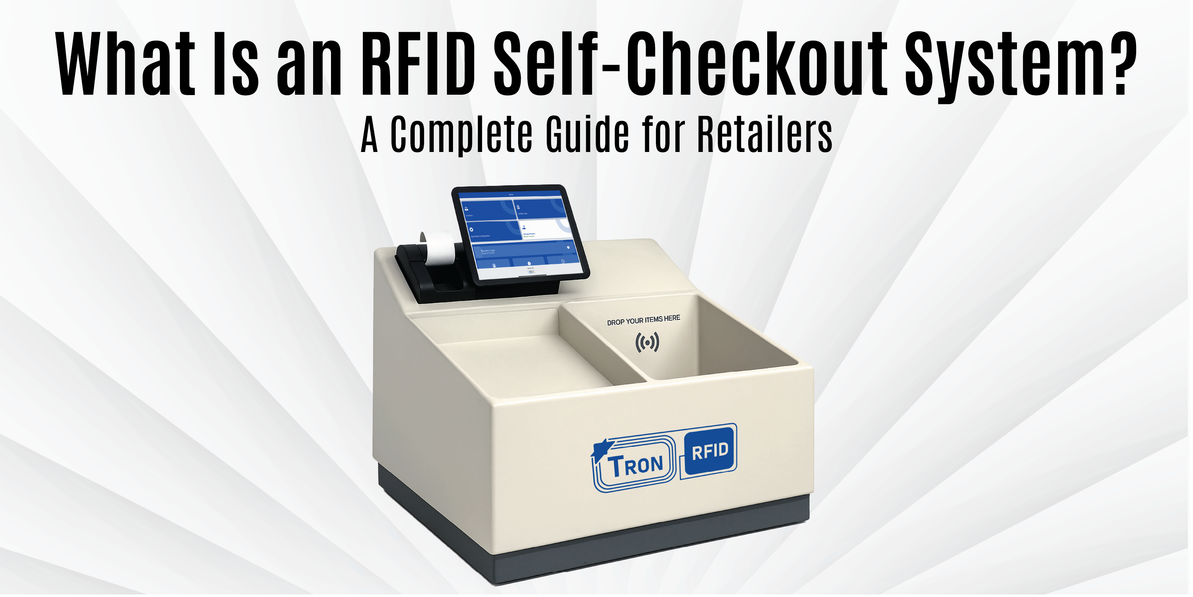
What Is an RFID Self-Checkout System? A Complete Guide for Retailers
Introduction
Retail checkout has seen a remarkable transformation over the years. What started with cash-only counters eventually moved to barcode scanners, and more recently, self-checkout kiosks. Each step has been driven by the same goal: making shopping faster and more convenient.
Today, customers expect speed, simplicity, and contactless experiences, especially in busy retail environments. This shift has put pressure on retailers to adopt smarter technologies that reduce wait times and improve efficiency. One innovation leading the way is RFID (Radio Frequency Identification). By enabling instant item recognition without manual scanning, RFID is redefining how self-checkout works and setting a new standard for modern retail.
What Is RFID Technology?
RFID, or Radio Frequency Identification, is a technology that uses small tags with microchips to store product details and communicate wirelessly with RFID readers. Unlike barcodes, which require manual scanning one item at a time, RFID can identify multiple products instantly, even if they’re inside a bag—without needing a direct line of sight.
Each product carries an RFID tag, and when placed near a reader, the system picks up signals, updates inventory, and generates accurate billing. This makes RFID faster, more efficient, and more reliable than traditional barcode systems, offering retailers better data and customers a smoother shopping experience.
What Is an RFID Self-Checkout System?
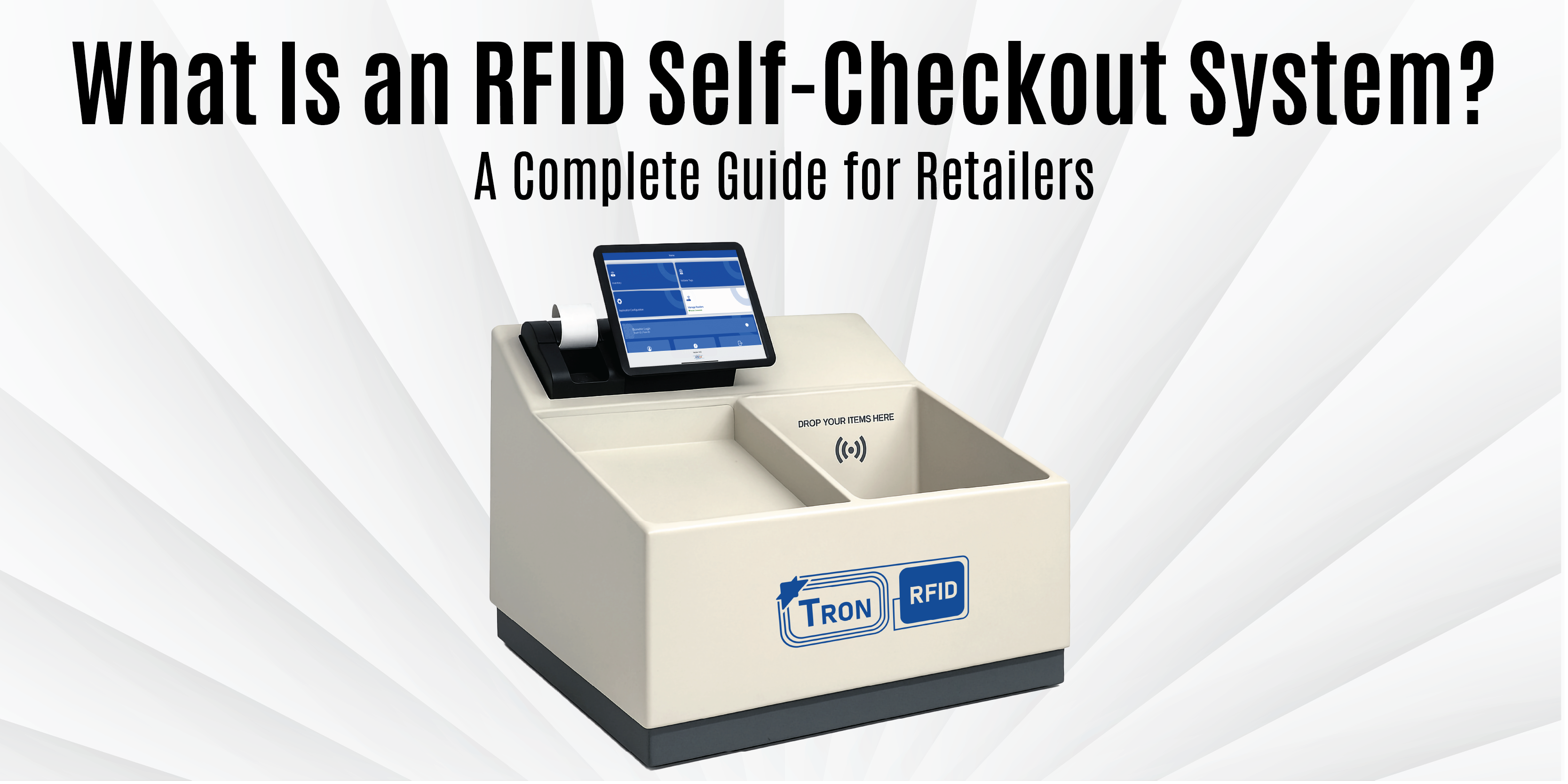
An RFID self-checkout system allows customers to place their items in a designated area where an RFID reader instantly scans everything. The system then displays the bill, and customers can pay using integrated payment options.
For RFID self-checkout to work, products must be RFID-labeled or RFID-tagged. Since many retailers already use RFID for inventory management, extending it to self-checkout is often a natural next step that builds on existing infrastructure.
Key components:
- RFID tags on products
- RFID readers at checkout stations
- Software to process transactions and update inventory
- Payment integration with POS systems
Compared to barcode self-checkout:
|
Feature |
Barcode Self-Checkout |
RFID Self-Checkout |
|
Scanning Method |
Requires manual scanning of each item, one by one |
Automatically scans multiple items at once without manual effort |
|
Speed |
Slower, especially with many items |
Much faster, reduces checkout time significantly |
|
Accuracy |
Prone to human error (missed scans, wrong barcodes) |
Highly accurate, items are instantly identified |
|
Customer Experience |
Can feel tedious and time-consuming |
Seamless, contactless, and convenient |
|
Inventory Management |
Updates only after manual scans |
Real-time inventory updates with every transaction |
|
Loss Prevention |
Limited, relies on staff monitoring |
Stronger, as RFID tracks items more effectively |
|
Technology Requirement |
Simple scanners and barcode labels |
RFID tags, readers, and integrated software |
Benefits of RFID Self-Checkout for Retailers
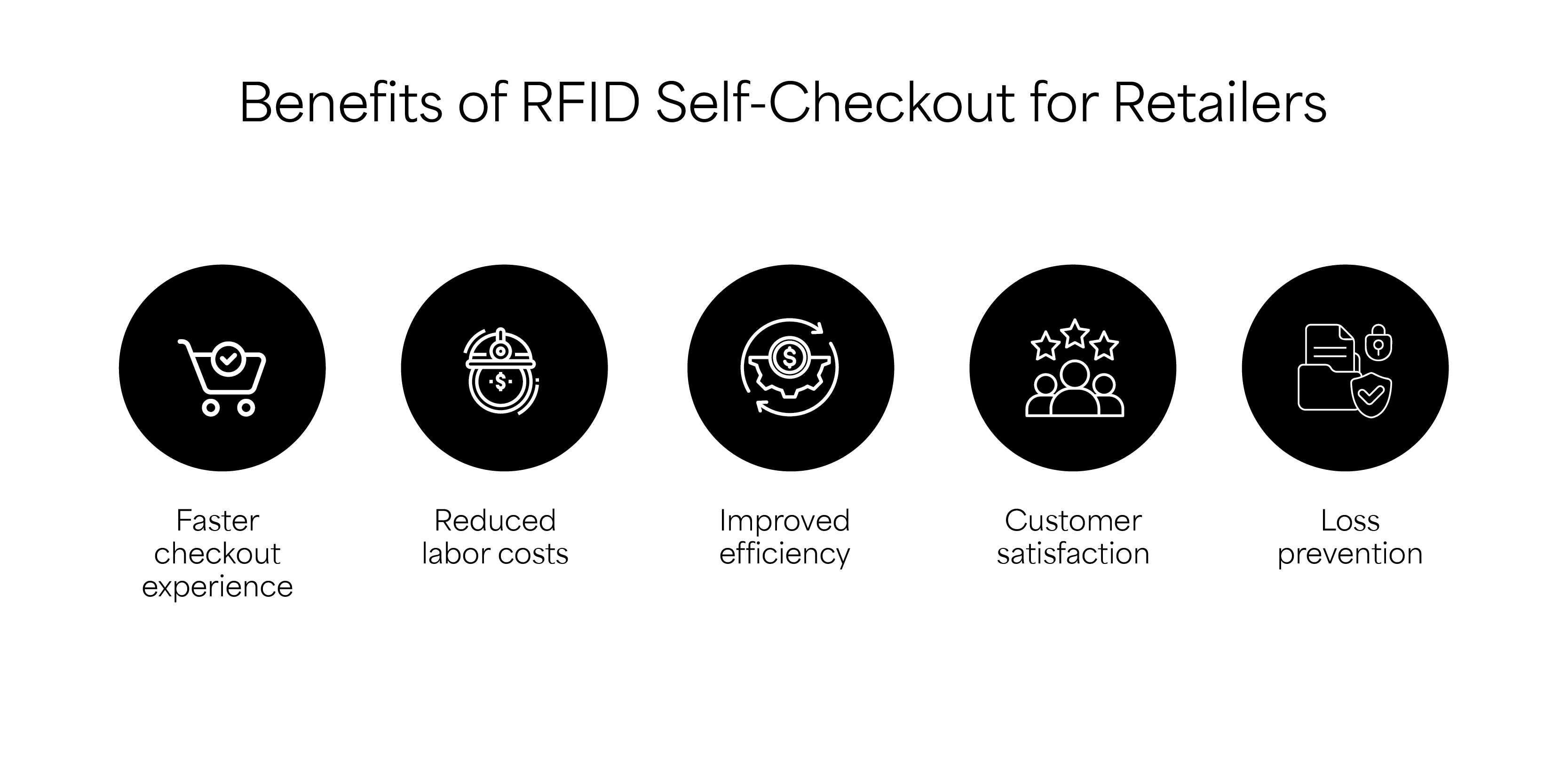
Faster checkout experience
RFID allows multiple items to be scanned instantly, reducing wait times and speeding up the checkout process, which helps retailers serve more customers efficiently during peak hours.
Reduced labor costs
With automated scanning, fewer staff are needed at checkout counters, allowing retailers to reallocate employees to customer service or other value-added tasks, ultimately lowering operational expenses.
Improved efficiency
RFID updates inventory in real time as items are purchased, minimizing errors and ensuring accurate stock levels, which helps retailers manage supply chains more effectively.
Customer satisfaction
A smooth, quick, and hassle-free shopping experience builds customer loyalty, encouraging repeat visits and positive word-of-mouth for the retailer.
Loss prevention
RFID technology tracks items more effectively than barcodes, helping retailers reduce theft and shrinkage while maintaining better control over their merchandise.
Benefits for Customers
- Seamless shopping: Customers don’t need to scan each item manually. RFID automatically identifies products, making checkout smooth and effortless.
- Shorter queues: Transactions are completed in seconds, reducing waiting times and improving the overall shopping experience.
- Transparency: Bills are accurate, with clear product details displayed instantly, ensuring customers feel confident about their purchases.
- Contactless convenience: RFID checkout minimizes physical touchpoints, offering a safer and more hygienic shopping process.
Challenges and Considerations
- Initial investment: Setting up RFID infrastructure requires significant upfront costs for tags, readers, and software, which can be a barrier for smaller retailers.
- System integration: RFID must work seamlessly with existing POS systems, requiring careful planning and technical compatibility checks.
- Training: Both staff and customers need guidance to adapt to RFID checkout, ensuring smooth operations and positive user experiences.
- Data security: Protecting customer information and product data is critical, as RFID systems rely on wireless communication that must be safeguarded.
- Maintenance and upgrades: RFID systems need regular updates and maintenance to stay efficient, adding ongoing costs and operational responsibilities for retailers.
Real-World Applications
Several global retailers have already embraced RFID self-checkout to enhance customer convenience and streamline operations. For example, Decathlon uses RFID technology to let customers scan all items at once, making checkout effortless and quick. Similarly, Uniqlo has implemented RFID tags across its stores, enabling faster billing and more accurate inventory management. These real-world applications show how RFID is not just a futuristic concept but a practical solution that improves efficiency, reduces wait times, and delivers a smoother shopping experience for both retailers and customers.
Future of RFID Self-Checkout in Retail
The future of RFID in retail is highly promising, with innovations set to make shopping even more seamless. Smarter checkout systems powered by automation and AI will boost speed and accuracy, while mobile integration will enable RFID-enabled apps for smartphone-based self-checkout. Additionally, RFID will strengthen omnichannel strategies by connecting online and offline shopping experiences, ensuring customers enjoy a consistent and convenient journey across all platforms.
Conclusion
RFID self-checkout systems are transforming retail by combining speed, accuracy, and convenience into one seamless process. Although the initial investment in infrastructure may feel significant, the long-term benefits—such as improved customer experiences, reduced operational costs, and real-time inventory control—make it a smart choice for forward-thinking retailers.
By adopting RFID, businesses can stay competitive, meet growing customer expectations, and position themselves for a future where efficiency and innovation define the shopping experience. Exploring RFID solutions today can help retailers build a stronger, future-ready strategy.
Recent Posts
-
5 Tag Placement Errors Ruining RFID Accuracy
Introduction Radio Frequency Identification has become a backbone of modern inventory management, re …Sep 8th 2026 -
RFID Asset Tracking for HVAC Companies
HVAC companies rely on a wide range of tools, vehicles, and spare parts to deliver timely service. M …Aug 25th 2026 -
Fix Inventory Inaccuracy with RFID Inventory Tracking Software
Introduction Inventory inaccuracy is one of the biggest challenges businesses face today. Manual err …Aug 12th 2026