
Upgrade from Barcodes to RFID on Shopify: A Retailer’s Guide
Retailers on Shopify are beginning to question whether barcodes are enough. With rising customer expectations and the need for faster, more accurate inventory management, barcodes often fall short. RFID (Radio Frequency Identification) offers speed, precision, and real-time visibility that barcodes simply can’t match.

In this guide, we’ll explain what RFID is, how it’s different from barcodes, the benefits of upgrading, and the practical steps you can take to bring RFID into your Shopify store.
Understanding RFID vs. Barcodes
What is RFID?
RFID uses small tags embedded with microchips that communicate with readers via radio waves. The system consists of:
- Tags: Attached to products, carrying unique data.
- Readers: Devices that scan multiple tags at once without direct line-of-sight.
- Software: Connects RFID data to your Shopify inventory system.
Key differences from barcodes:
|
Feature |
Barcodes |
RFID |
Why It Matters for Shopify Retailers |
|
Scanning Method |
Needs line-of-sight (each item scanned one by one) |
No line-of-sight needed (tags read automatically) |
Saves time during inventory counts |
|
Speed |
Slow – scans single items |
Fast—scans hundreds at once |
Speeds up stock checks and restocking |
|
Accuracy |
Around 60% in cycle counts |
98%+ accuracy |
Reduces errors and overselling |
|
Data Capacity |
Limited—only basic product info |
Can store more details (e.g., batch, expiry) |
Helps with advanced tracking |
|
Durability |
Labels can fade or tear |
Tags are more durable |
Longer-lasting inventory labels |
|
Customer Impact |
Risk of stockouts and wrong counts |
Real-time updates improve reliability |
Better shopping experience |
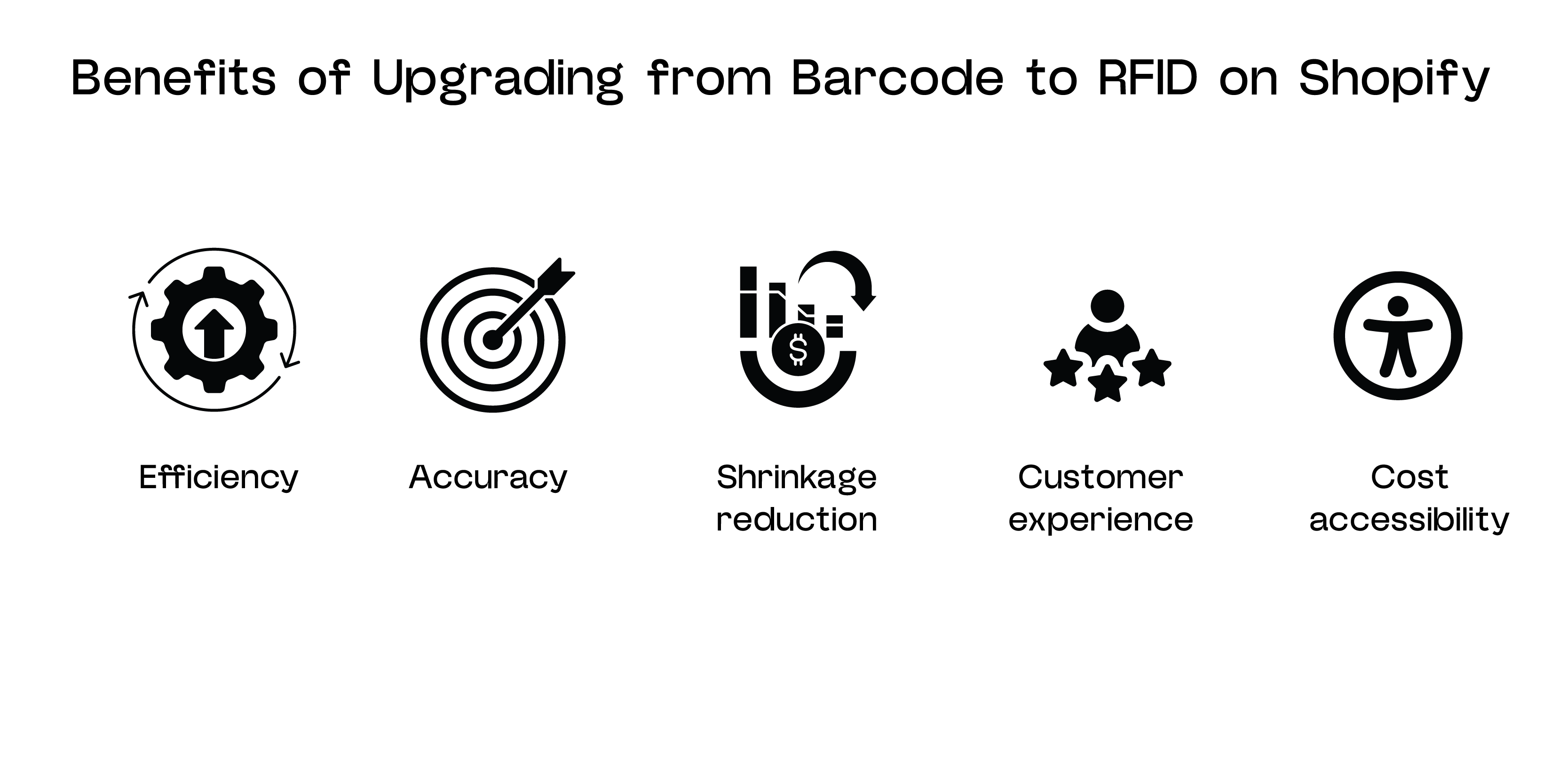
Benefits of Upgrading from Barcode to RFID on Shopify
Efficiency
RFID lets you scan hundreds of items in seconds, instead of scanning each barcode one by one. This saves time during stock checks and makes inventory management much faster.
Accuracy
With real-time updates, RFID helps prevent overselling and stockouts. Retailers can trust their inventory numbers, reducing mistakes and ensuring customers get what they order.
Shrinkage Reduction
RFID reduces losses from theft and human errors. Since items are tracked more precisely, retailers can spot missing products quickly and keep tighter control over inventory.
Customer Experience
Faster order processing and fewer mistakes mean happier customers. RFID ensures smoother fulfillment, fewer delays, and a more reliable shopping experience both online and in-store.
Cost Accessibility
Passive RFID tags have become affordable, making it easier for small and medium Shopify retailers to adopt the technology without high upfront costs.
Getting Ready to Switch from Barcodes to RFID
Before switching from barcode to RFID, Shopify retailers should:
- Assess the current barcode setup: Review inventory size, POS integration, and pain points.
- Define goals: Examples include faster counts, reduced errors, or omnichannel readiness.
- Budget considerations: Factor in tags, readers, middleware, and staff training.
- Change management: Train staff and adjust workflows to ensure smooth adoption.
Step-by-Step Shopify RFID Upgrade Guide
Evaluate RFID solutions
Start by exploring RFID systems that work smoothly with Shopify POS. Look for options that fit your store size, budget, and inventory needs before making any commitments. Companies like RFID4U help retailers move from barcodes to RFID by offering solutions that improve inventory accuracy, speed up cycle counts, and connect seamlessly with Shopify. This makes it easier to test, adopt, and scale RFID without disrupting daily operations.
Pilot test RFID tags
Apply RFID tags to a small product category first. This helps you test the process, measure improvements, and identify challenges without disrupting your entire store.
Integrate RFID readers
Connect RFID readers with your Shopify inventory system. This ensures scanned data flows directly into your POS, keeping stock levels accurate and updated in real time.
Automate stock updates
Use RFID to update inventory counts and reporting dashboards automatically. This reduces manual work, saves time, and gives you reliable data for better decision-making.
Scale across catalog
Once you see positive results and ROI from your pilot, expand RFID tagging across your full product catalog. This step maximizes efficiency and accuracy store-wide.
Seamless RFID Integration with Shopify POS
RFID works smoothly with Shopify POS, keeping inventory levels updated across online and offline channels. Real-time synchronization prevents stock errors, while faster cycle counts reduce mismatches. Using inventory apps or RFID middleware helps connect hardware with Shopify without locking retailers into a single vendor.
Overcoming RFID Adoption Challenges with Confidence
- Initial Investment Costs: RFID may require upfront spending, but starting with small pilot projects helps retailers test benefits, prove ROI, and scale gradually with confidence.
- Technical Setup: Setting up RFID can feel complex, but working with experienced Shopify experts or RFID integrators ensures smooth integration and reliable performance from the start.
- Staff Adoption: Employees may need time to adjust, but clear training sessions and simple SOPs make RFID easy to use, boosting confidence and efficiency across the team.
- Data Migration: Moving from barcodes to RFID requires clean SKU mapping, but careful planning and organized data transfer ensure accuracy and prevent inventory mismatches during the transition.
Future-Proofing Your Retail Operations
RFID is more than inventory tracking—it’s the base for smarter retail. It supports IoT connections, enables AI-driven demand forecasting, and prepares retailers for omnichannel growth. With RFID, Shopify stores can meet customer expectations for speed, accuracy, and reliability across all sales channels.
Conclusion
Barcodes have supported retailers for years, but RFID is the smarter next step. With faster inventory counts, higher accuracy, and real-time visibility, Shopify retailers can reduce errors, improve customer satisfaction, and prepare for future growth. Starting with a pilot project makes adoption easier and sets the stage for long-term success.
Frequently Asked Questions
Why should retailers upgrade from barcodes to RFID on Shopify?
RFID offers real-time visibility, faster scanning, and higher accuracy compared to barcodes, helping retailers streamline inventory and reduce errors.
How do RFID tags differ from barcodes in retail operations?
Barcodes require line-of-sight and one-by-one scanning, while RFID tags can be read in bulk without line-of-sight, saving time and labor.
Can RFID integrate directly with Shopify?
Yes. RFID integrates with Shopify POS and inventory systems, ensuring seamless synchronization of stock data across online and offline channels.
What are the benefits of RFID for Shopify retailers?
Benefits include improved inventory accuracy, reduced shrinkage, faster checkout, better customer experience, and stronger omnichannel fulfillment.
How does RFID improve inventory management compared to barcodes?
RFID enables bulk cycle counts in minutes, while barcodes require manual scanning that can take hours or days.
Is RFID scalable for small and medium Shopify stores?
Absolutely. RFID solutions can be tailored for boutiques, mid-sized retailers, or large enterprises, making them flexible and scalable.
Does RFID improve customer experience in Shopify stores?
RFID ensures products are available when customers want them, supports faster checkout, and enables services like Buy Online, Pick Up In Store (BOPIS).
Recent Posts
-

RFID Tag Placement Secrets Every Clothing & Footwear Brand Must Know
Introduction RFID technology has become a game-changer in the apparel and footwear industry. From re …Mar 30th 2026 -
How RFID Solves Shopify Inventory Challenges for D2C Brands
Shopify has quickly become the preferred platform for Direct-to-Consumer (D2C) brands. Its flexibili …Mar 16th 2026 -

RFID vs Barcode in Retail: A Side-by-Side Comparison
Introduction Retail is transforming at a rapid pace, and at the center of this change lies inventory …Mar 6th 2026