

RFID Tags in Retail for Smart Inventory Tracking
Introduction
Inventory management has always been one of the toughest challenges in retail. Stockouts frustrate customers, overstocking ties up capital, and manual errors eat into profits. In today’s competitive environment, retailers can’t afford to guess what’s on their shelves—they need precision.
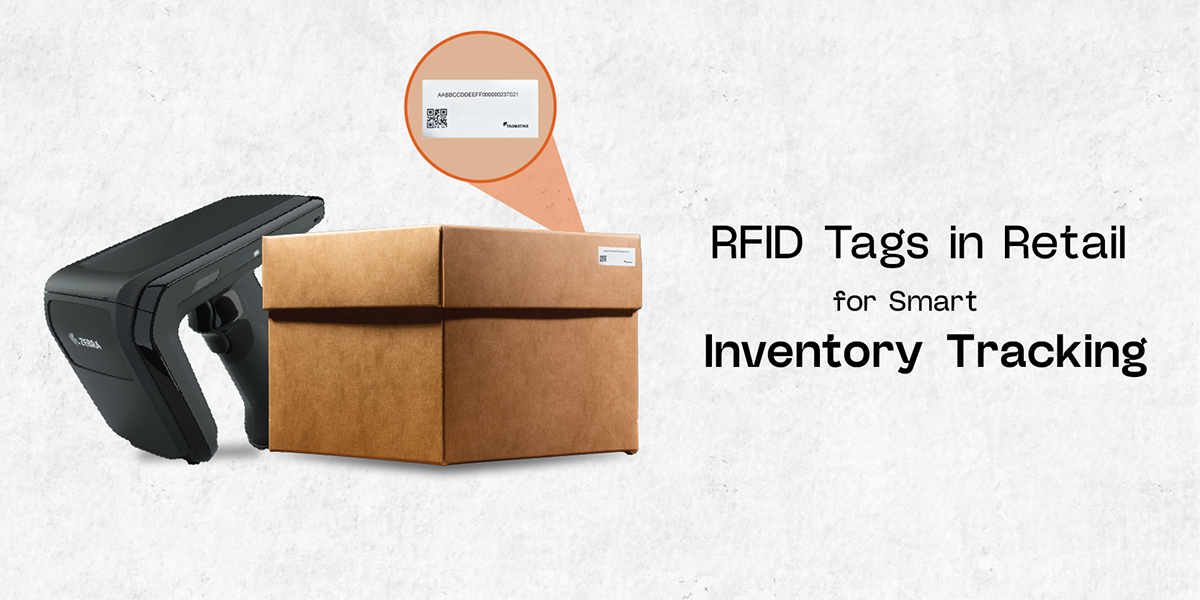
This is where RFID tags step in. Unlike traditional systems that rely on manual scanning or barcodes, RFID tags give every product its own digital identity. They are the backbone of smart inventory tracking, enabling retailers to see, manage, and control stock in real time.
From apparel to groceries, RFID tags are redefining how retailers operate and how customers experience shopping.
Understanding RFID Tags in Retail
At their core, RFID tags are tiny chips embedded in labels or packaging. Each tag carries a unique identifier that can be read wirelessly by RFID readers.
Passive RFID tags: These are the most common in retail. They don’t have a battery; instead, they draw power from the reader’s signal. They’re cost-effective and ideal for tagging large volumes of products.
How they differ from barcodes and QR codes:
Unlike barcodes and QR codes, which need to be scanned one by one and require a clear line of sight, RFID tags work very differently. They can be read in bulk, even if the items are stacked together or hidden inside packaging. This means a retailer doesn’t have to spend time manually scanning each product—hundreds of items can be identified in seconds. For busy retail environments where speed and accuracy matter, RFID tags offer a far more efficient way to keep track of inventory.
RFID vs Barcodes: At Scale
|
Aspect |
Barcodes / QR Codes |
RFID Tags |
|
Scanning Method |
Require line-of-sight scanning, one item at a time |
Can be scanned in bulk, even without direct visibility |
|
Speed of Identification |
Slow process, each product must be scanned individually |
Hundreds of items can be identified within seconds |
|
Packaging / Placement |
Must be visible to the scanner |
Can be read through the packaging or when items are stacked |
|
Efficiency in Retail |
Time-consuming and prone to manual errors |
Highly efficient, saves time, and improves accuracy in busy retail environments |
|
Impact on Operations |
Increases labor effort and slows down inventory management |
Streamlines inventory tracking, reduces workload, and ensures faster, more reliable updates |
How RFID Tags Enable Smart Inventory Tracking
RFID tags transform inventory management by making every product “smart.”
- Real-time visibility: Each item carries its own digital identity, so retailers always know what’s in stock.
- Bulk scanning: Hundreds of tagged items can be read simultaneously, saving hours of manual work.
- Automated updates: Tags communicate with readers to instantly update stock levels in the system.
- System integration: RFID tags connect seamlessly with POS, ERP, and warehouse management systems, ensuring data consistency across the business.
Benefits of RFID Tags for Retail Inventory
Retailers adopting RFID tags see measurable improvements:
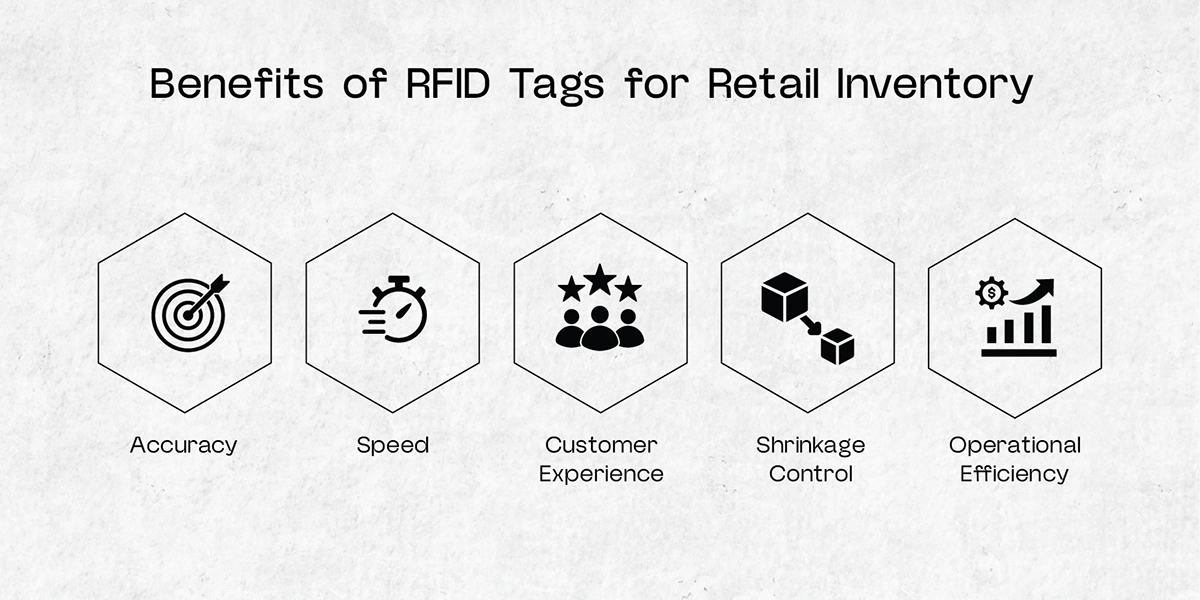
Accuracy
RFID tags allow retailers to achieve near-perfect inventory accuracy, often reaching 95–99%. This is a huge improvement compared to manual or barcode methods, which typically hover around 60–70%. Accurate data ensures better decision-making and fewer costly mistakes.
Speed
Traditional cycle counts could take days or even weeks, especially in large stores. With RFID tags, hundreds of items can be scanned in minutes. This speed not only saves time but also allows staff to focus on customer service.
Customer Experience
When inventory is tracked correctly, products are available when customers want them. RFID tags reduce frustrating “out of stock” situations, helping retailers deliver a smoother shopping experience. Satisfied customers are more likely to return and build loyalty with the brand.
Shrinkage Control
Retail shrinkage due to misplaced items is a significant concern. RFID tags help track products more effectively, making it easier to identify losses quickly. This added visibility reduces shrinkage and protects profits without requiring heavy manual monitoring.
Operational Efficiency
By automating inventory tasks, RFID tags cut down on repetitive manual work. Staff spend less time scanning or counting items, which lowers labor costs. Operations run more smoothly, and retailers can redirect resources toward growth and customer engagement.
Practical Applications of RFID Tags in Retail
RFID tags aren’t just theoretical—they’re already transforming retail operations:
Apparel
RFID tags make it possible to track clothing at the item level, including size, color, and style. This ensures shelves are stocked correctly, reduces errors during replenishment, and helps retailers deliver a smoother shopping experience for customers.
Grocery
In grocery stores, RFID tags help monitor perishable goods and expiry dates. By tracking freshness more accurately, retailers can reduce waste, improve food safety, and ensure customers always find high-quality products available on the shelves.
Electronics
High-value electronics benefit greatly from RFID tagging. Tags help simplify warranty validation and provide retailers with better visibility of stock movement. This reduces shrinkage and builds customer trust when purchasing expensive or sensitive items.
Omnichannel Retail
RFID tags support modern retail models like click-and-collect and online fulfillment. By ensuring accurate stock visibility across stores and warehouses, retailers can fulfill orders faster, reduce cancellations, and provide customers with a seamless omnichannel shopping experience.
Pharma and Liquid Bottles
Specialized flag RFID tags are used in liquid-filled bottles and pharmaceutical products. These tags ensure accurate tracking of sensitive items, improve safety compliance, and help retailers and suppliers manage inventory in industries where precision is critical.
Jewelry
Jewelry RFID labels are designed for small, high-value items. They allow retailers to track rings, necklaces, and other pieces individually, reducing risk and ensuring accurate stock counts in a category where even minor losses can be costly.
Cosmetics and Metal Packaging
On-metal RFID labels, such as those sized 45.72 x 17.78 x 1.5 mm, are ideal for cosmetics packaged in metal boxes. These specialized tags overcome interference issues, enabling reliable tracking of beauty products and improving inventory accuracy in cosmetics retail.
Challenges in Deploying RFID Tags
Deploying RFID tags in retail comes with a few challenges that retailers must plan for. The upfront cost of tags, readers, and integration can be significant. Tags also need to withstand conditions like heat, moisture, and packaging. Data privacy must be safeguarded, and older systems may require upgrades for smooth integration.
How to Choose RFID Tags for Retail Inventory Tracking
Retailers should consider:
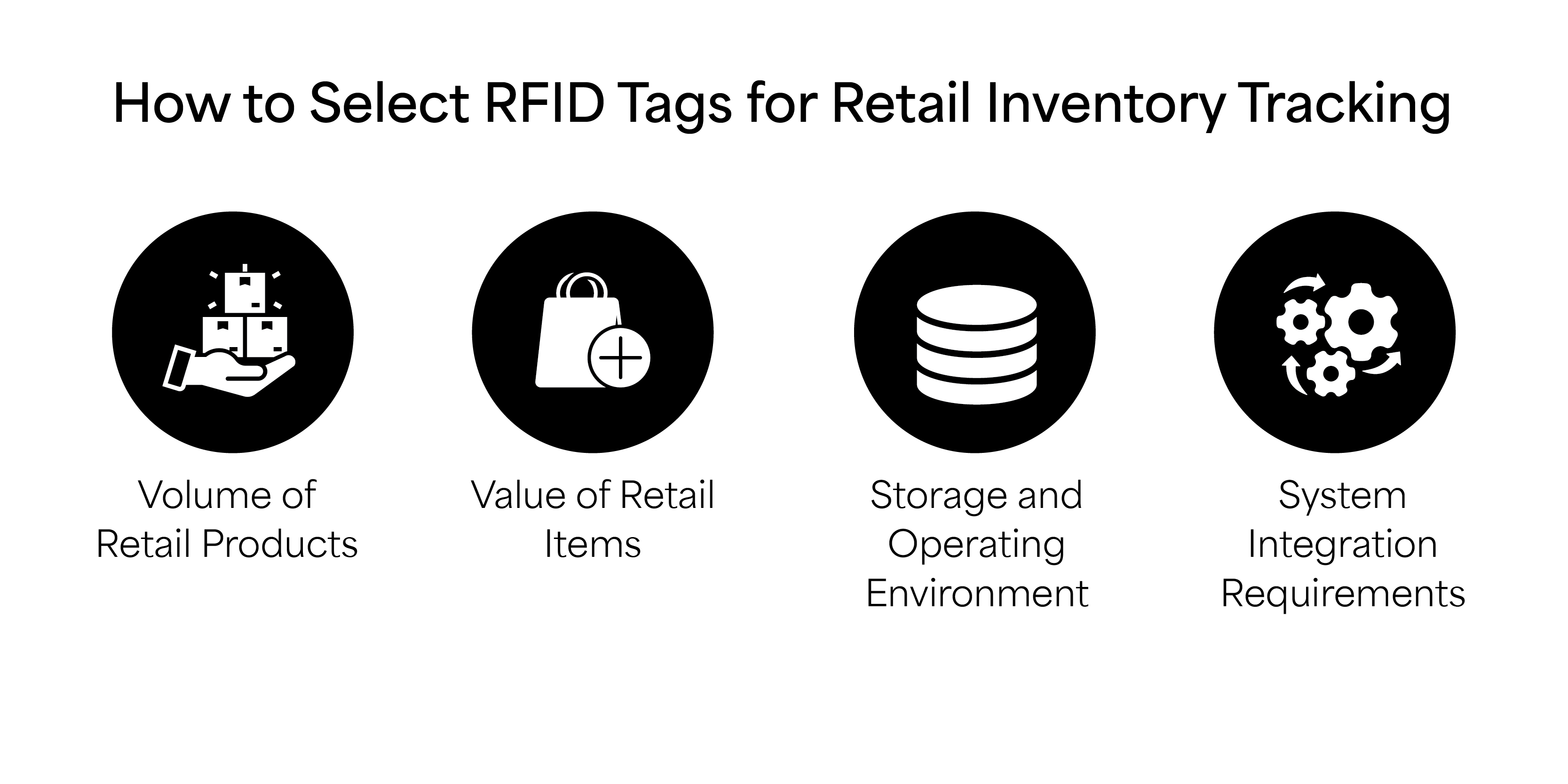
Volume of Products: For large inventories with thousands of items, passive RFID tags are the most cost-effective choice. They provide reliable tracking without adding significant expense per product.
Value of Items: High-value goods, such as electronics or luxury items, require stronger monitoring solutions. RFID tags can be configured to provide reliable signals and extended ranges, helping retailers improve security, track movement, and maintain tighter control over valuable inventory.
Environment: Tags must be durable enough to withstand storage conditions like cold, heat, or moisture. Choosing the right material ensures consistent performance and prevents tracking issues in challenging environments.
Integration Needs: RFID tags should work seamlessly with existing POS, ERP, or warehouse systems. Compatibility ensures smooth adoption and accurate data flow and avoids costly disruptions during implementation.
Choosing the right tag type ensures maximum ROI and smooth adoption.
Conclusion
RFID in retail is more than a technology upgrade—it is the foundation of smart inventory tracking. By using RFID tags, retailers achieve higher accuracy, faster operations, and stronger customer trust, while cutting waste and costs. Adopting RFID ensures long-term efficiency and future-proof retail businesses.
The future of retail is smart, connected, and precise. RFID tags are the key to unlocking it.
Frequently Asked Questions (FAQs)
What are RFID tags in retail?
RFID tags are tiny chips embedded in labels or packaging that carry a unique identifier, enabling retailers to track products wirelessly and in real time.
How do RFID tags differ from barcodes and QR codes?
Unlike barcodes and QR codes, which require line-of-sight scanning one item at a time, RFID tags can be read in bulk, even through packaging or stacked items, saving significant time.
What types of RFID tags are commonly used in retail?
Passive RFID tags are most common in retail. They don’t have a battery and draw power from the reader’s signal, making them cost-effective for tagging large volumes of products.
How do RFID tags enable smart inventory tracking?
RFID tags provide real-time visibility, bulk scanning, automated updates, and seamless integration with POS, ERP, and warehouse systems, ensuring accurate stock data.
How do RFID tags improve speed in inventory management?
Traditional cycle counts can take days or weeks, while RFID allows hundreds of items to be scanned in minutes, freeing staff to focus on customer service.
Can RFID tags enhance customer experience?
Yes. By ensuring products are available when customers want them, RFID reduces “out of stock” frustrations and builds customer loyalty.
How do RFID tags help control shrinkage in retail?
RFID provides better visibility of product movement, making it easier to identify misplaced or stolen items and reduce shrinkage.
Recent Posts
-

RFID Tag Placement Secrets Every Clothing & Footwear Brand Must Know
Introduction RFID technology has become a game-changer in the apparel and footwear industry. From re …Mar 30th 2026 -
How RFID Solves Shopify Inventory Challenges for D2C Brands
Shopify has quickly become the preferred platform for Direct-to-Consumer (D2C) brands. Its flexibili …Mar 16th 2026 -
RFID vs Barcode in Retail: A Side-by-Side Comparison
Introduction Retail is transforming at a rapid pace, and at the center of this change lies inventory …Mar 6th 2026