

RFID Readers Buying Guide — Everything You Need to Know
Introduction
Radio Frequency Identification (RFID) is a technology that uses radio waves to identify and track objects. At the heart of every RFID system is the RFID reader—the device that communicates with RFID tags to capture data. Without readers, RFID tags are just labels; readers bring them to life by collecting and transmitting information to RFID software systems.

This guide is designed to help business owners, beginners, and decision-makers understand RFID readers, compare options, and make smart buying choices.
Understanding RFID Readers
An RFID reader is the device that sends signals to RFID tags and receives their responses. It acts as the bridge between physical items and digital systems.
How Readers Work
When an RFID tag enters the reader’s range, the antenna emits radio waves. The tag responds with its stored data (like ID number or product info). The reader captures this data and passes it to software such as inventory management or ERP systems.
Types of RFID Readers
When it comes to RFID readers, one size doesn’t fit all. Different industries and use cases call for different types of devices. Below are the main categories of RFID readers, explained in simple terms with practical examples.
Fixed Readers
Fixed readers are installed in permanent locations such as entry and exit points, conveyor belts, or dock doors. They continuously scan tags as items move past them, making them perfect for environments where tracking needs to happen automatically without human intervention.
- Where they’re used: Warehouses, retail stockrooms, and manufacturing plants.
- Example scenario: In a warehouse, fixed readers at dock doors can automatically record when pallets enter or leave, eliminating the need for manual scanning.
Why choose them? If your business needs constant monitoring and you want to reduce manual labor, fixed readers are the most reliable option.
Handheld Readers
Handheld readers look and feel similar to barcode scanners. They’re portable, which means staff can carry them around to scan items wherever needed.
- Where they’re used: Inventory checks, asset audits, and field operations.
- Example scenario: A retail associate can walk through the store with a handheld reader to quickly verify stock levels on shelves.
Why choose them? They’re flexible, easy to use, and ideal for businesses that need mobility rather than fixed installations.
Integrated Readers
Integrated readers combine the reader and antenna into one compact device. Because they don’t require separate antennas or complex setups, they’re easy to install and manage.
- Where they’re used: Retail stores, healthcare facilities, and offices where space is limited.
- Example scenario: In a hospital, integrated readers can be placed in supply cabinets to track medical equipment automatically.
Why choose them? They save space, simplify deployment, and are great for smaller environments that still need reliable RFID tracking.
Mobile/Smartphone-Based Readers
These readers use attachments to read RFID tags. They’re the most cost-effective option and are especially useful for small businesses or organizations that don’t need large-scale RFID infrastructure.
- Where they’re used: Libraries, educational institutions, and small retail shops.
- Example scenario: A library staff member can use a smartphone with an RFID attachment to check books in and out quickly.
Why choose them? They’re affordable, easy to adopt, and perfect for businesses just starting with RFID technology.
Comparison Table: Types of RFID Readers
|
Type of Reader |
Best Use Cases |
Pros |
Cons |
Example Scenario |
|
Fixed Readers |
Warehouses, retail stockrooms, manufacturing |
Continuous monitoring, automated tracking, and high accuracy |
Higher installation cost, requires a permanent setup |
Dock doors automatically record pallets entering or leaving without manual scanning. |
|
Handheld Readers |
Inventory checks, asset audits, field operations |
Portable, flexible, easy to use, and cost-effective for smaller deployments |
Requires manual operation, limited coverage compared to fixed |
Retail staff quickly scan shelves to verify stock levels. |
|
Integrated Readers |
Retail stores, healthcare, and offices |
Compact design, easy installation, no separate antenna needed |
Limited range, less scalable for large facilities |
Hospital supply cabinets track medical equipment automatically. |
|
Mobile/Smartphone-Based |
Libraries, education, and small retail shops |
Affordable, simple to adopt, uses existing smartphone attachments |
Shorter range, not suitable for large-scale operations |
Library staff check books in/out using a smartphone attachment. |
Key Specifications to Consider
When buying an RFID reader, it’s not just about picking a device that looks good or fits your budget. The specifications determine how well the reader will perform in your environment and whether it will meet your long-term needs. Let’s break down the most important factors.
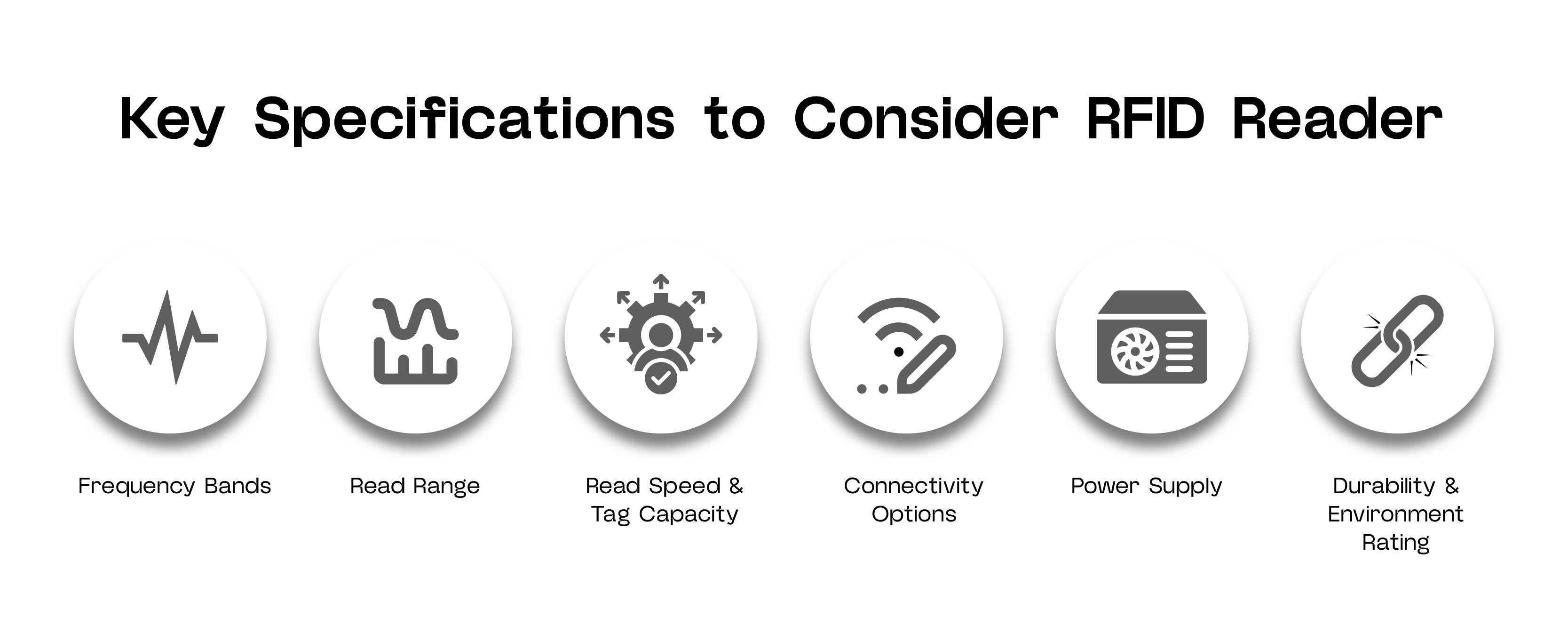
Frequency Bands
RFID readers operate on different frequency ranges, and each has its own strengths:
- LF (Low Frequency): Short range (usually a few centimeters). Commonly used for access control systems like employee ID badges or animal tracking.
- HF (High Frequency): Medium range (up to 1 meter). Popular in ticketing, library systems, and payment cards.
- UHF (Ultra High Frequency): Long range (up to several meters). Widely used in retail, supply chain, and warehouse automation because it can read many tags quickly.
Always check regional compliance before buying. For example, the US follows FCC regulations, while Europe follows ETSI standards. Using the wrong frequency can cause interference or even legal issues.
Read Range
The read range tells you how far the reader can detect tags.
- Short-range readers are perfect for applications like access control or point-of-sale systems.
- Long-range readers are better for warehouse automation, logistics, or vehicle tracking, where items need to be scanned from several meters away.
Think of it like choosing between a flashlight for close-up work versus a floodlight for covering a large area.
Read Speed & Tag Capacity
In environments where hundreds of items move at once—like a warehouse or distribution center—you need a reader that can handle bulk reading.
- A good reader should capture multiple tags in seconds without missing data.
- This is especially important in logistics, where pallets or cartons with dozens of tags pass through a dock door simultaneously.
Connectivity Options
How your reader connects to your system matters for smooth operations.
- Wi-Fi or Bluetooth: Great for handheld readers, offering mobility and wireless convenience.
- Ethernet or USB: Reliable for fixed readers, ensuring stable connections in warehouses or retail stores.
Choose based on your existing infrastructure—there’s no point in buying a Wi-Fi-enabled reader if your facility relies on wired connections.
Power Supply
Power requirements vary depending on the type of reader:
- Handheld readers: Depend on battery life. Always check how long the battery lasts and whether it supports fast charging.
- Fixed readers: Often use Power over Ethernet (PoE), which simplifies installation by delivering both power and data through a single cable.
Durability & Environment Rating
Not all readers are built for the same conditions.
- If you’re using readers outdoors or in industrial environments, look for IP-rated devices (Ingress Protection). For example, IP65 means the reader is dust-tight and protected against water jets.
- Rugged readers are essential in manufacturing plants, construction sites, or logistics hubs, where dust, moisture, or rough handling are common.
Choosing the Right Reader for Your Industry
Retail
RFID readers streamline inventory checks, reduce theft, and speed up checkout. Fixed or handheld devices help retailers maintain stock accuracy, improve customer experience, and cut losses with automated monitoring.
Manufacturing
Readers track work-in-progress, tools, and raw materials. Fixed units on production lines ensure smooth workflows, while handhelds locate equipment quickly, reducing downtime and boosting efficiency across manufacturing operations.
Healthcare
RFID readers track medical equipment and verify medications. Wristbands, integrated cabinets, and handheld devices ensure accurate identification, reduce errors, and keep critical supplies available when needed.
Logistics & Supply Chain
Readers verify shipments, automate warehouse operations, and reduce errors. Fixed readers at dock doors and conveyor belts capture bulk data, ensuring faster, more accurate movement of goods across supply chains.
Libraries & Education
RFID readers simplify book tracking and manage student IDs. Integrated kiosks allow quick self-checkouts, while HF readers support attendance systems, making resource management easier for schools and libraries.
Integration & Compatibility
- Middleware & Software: Ensure compatibility with ERP, WMS, or POS systems.
- Antenna Compatibility: Multi-port readers allow multiple antennas for wider coverage.
- Tag Standards: Look for ISO/IEC compliance and EPC Gen2 support.
- APIs & SDKs: Developer tools make customization easier.
Cost Factors & ROI
When investing in RFID readers, costs go beyond the device itself. Entry-level models are more affordable, while enterprise-grade readers come at a higher price. Businesses should also factor in installation, antennas, cabling, and software licenses. The return on investment often comes through reduced labor, improved accuracy, and lower shrinkage, making RFID a smart long-term choice.
Common Mistakes to Avoid
Ignoring Frequency Regulations
Using readers without checking regional frequency rules can cause interference or legal issues. Always confirm compliance with FCC, ETSI, or local standards before purchase.
Overlooking Environmental Conditions
Metal and liquids disrupt RFID signals. Ignoring these factors leads to poor performance. Plan antenna placement and choose suitable readers for challenging environments.
Failing to Plan for Scalability
Starting small without considering growth can be costly. Select readers that support expansion, multiple antennas, and easy integration to avoid future upgrades.
Choosing the Low-Cost Option
Low-cost readers often lack durability, support, or compatibility. Investing in reliable devices with warranties ensures long-term savings and consistent performance.
Top Brands & Models
When exploring RFID readers, you’ll find that multiple brands (Zebra, Chainway, Impinj, Honeywell and more) offer a wide range of models designed for different industries and applications. Some are better suited for retail and logistics, others excel in industrial environments, while certain options focus on handheld or compact devices. Each brand typically provides both entry-level and advanced models, so the best choice depends on your specific use case, budget, and long-term support needs rather than the name itself.
Each brand has entry-level and advanced models—compare based on your use case, budget, and support needs.
Buying Checklist
- Define your use case clearly.
- Match reader type to your application.
- Verify regional compliance with frequency laws.
- Check integration with existing systems.
- Evaluate vendor support and warranty before purchase.
Conclusion
RFID readers are the backbone of modern tracking and automation, helping businesses across industries improve accuracy, efficiency, and security. From retail shelves to hospital equipment, the right reader ensures smooth operations and long‑term value. By understanding types, specifications, costs, and common pitfalls, you can make confident decisions that fit your unique needs. Investing in the right RFID solution today sets the foundation for smarter workflows and stronger returns tomorrow.
Frequently Asked Questions (FAQs)
What is an RFID reader?
An RFID reader is the device that sends signals to RFID tags and receives their responses, acting as the bridge between physical items and digital systems.
How do RFID readers work?
When an RFID tag enters the reader’s range, the antenna emits radio waves. The tag responds with its stored data, which the reader captures and passes to software systems like ERP or inventory management.
Which industries use RFID readers most?
RFID readers are widely used in retail, manufacturing, healthcare, logistics, libraries, and education, each benefiting from improved tracking and automation.
How important is read range in RFID readers?
Read range determines how far a reader can detect tags. Short-range readers are ideal for access control, while long-range readers are better for warehouses and logistics.
What specifications should be considered when buying an RFID reader?
Key factors include frequency compliance, read speed, tag capacity, connectivity options (Wi-Fi, Bluetooth, Ethernet), power supply, and durability (IP ratings).
What is the ROI of investing in RFID readers?
While upfront costs may be higher, RFID readers deliver ROI through reduced labor, improved accuracy, lower shrinkage, and faster operations, making them a smart long-term investment.
Recent Posts
-

RFID Tag Placement Secrets Every Clothing & Footwear Brand Must Know
Introduction RFID technology has become a game-changer in the apparel and footwear industry. From re …Mar 30th 2026 -
How RFID Solves Shopify Inventory Challenges for D2C Brands
Shopify has quickly become the preferred platform for Direct-to-Consumer (D2C) brands. Its flexibili …Mar 16th 2026 -
RFID vs Barcode in Retail: A Side-by-Side Comparison
Introduction Retail is transforming at a rapid pace, and at the center of this change lies inventory …Mar 6th 2026