
RFID vs Barcode in Retail: A Side-by-Side Comparison
Introduction
Retail is transforming at a rapid pace, and at the center of this change lies inventory tracking. For decades, barcodes have been the trusted standard—affordable, simple to use, and universally recognized across industries. They’ve powered checkout counters, streamlined product labeling, and kept shelves organized.
Yet, as customer expectations grow and supply chains become more complex, retailers are demanding faster, more accurate, and more transparent systems. This is where RFID (Radio Frequency Identification) technology is stepping in. With its ability to scan multiple items at once and provide real-time visibility, RFID is reshaping how businesses manage inventory.
In this blog, we’ll break down the strengths and limitations of both barcodes and RFID, offering a clear, side-by-side comparison to help retailers decide which solution best fits their needs today—and in the future.
What is Barcode Technology?
Barcodes are machine-readable codes that store product information in black-and-white lines. Introduced in the 1970s, they revolutionized checkout and inventory management.
- How it works in retail: A scanner reads the barcode, retrieves product data, and updates the system.
- Applications: Point-of-sale checkout, product labeling, and basic inventory tracking.
- Strengths: Simple, low-cost, and universally recognized.
- Limitations: Requires line-of-sight scanning, prone to human error, and less efficient for bulk inventory.
What is RFID technology?
Radio Frequency Identification (RFID) is a technology that uses tags and readers to transmit data wirelessly. Unlike barcodes, RFID does not require line-of-sight scanning and can identify multiple items at once, making it far more efficient in environments with large or complex inventories.
How it works in retail:
RFID tags—either passive (powered by the reader’s signal) or active (with their own battery)—communicate with RFID readers. When scanned, these tags instantly send product details to the system, updating inventory records in real time. This ability to streamline processes and improve accuracy highlights the growing importance of RFID in retail operations.
Applications in retail:
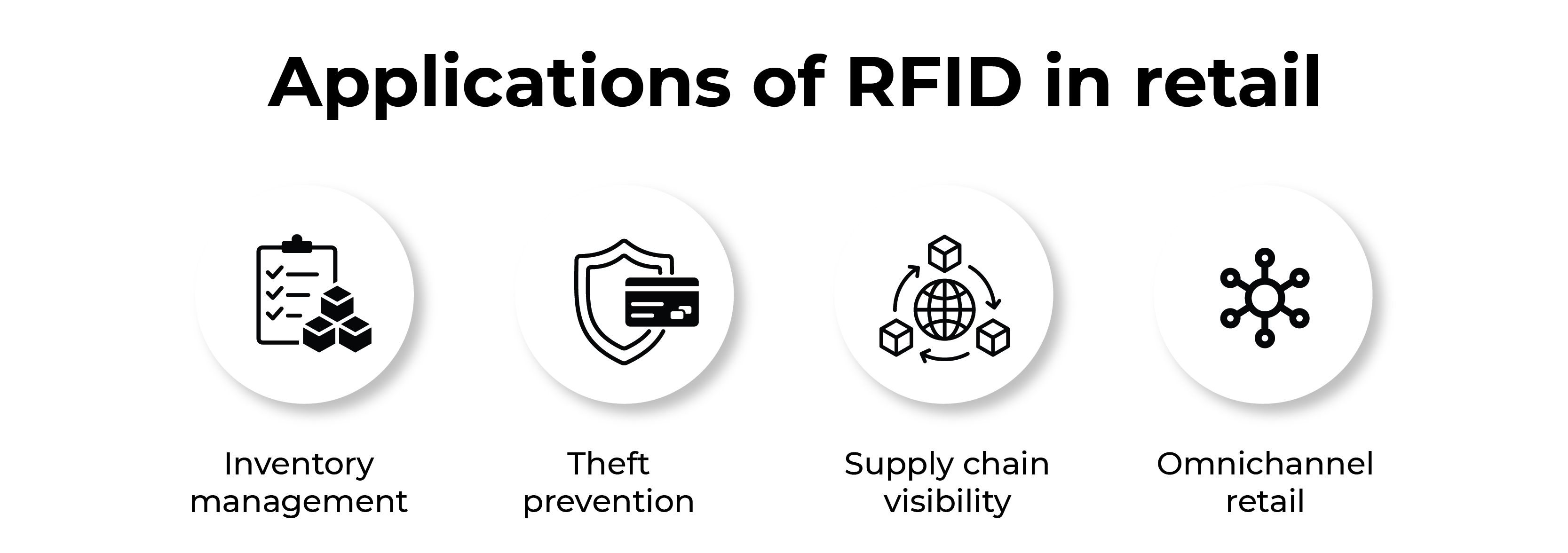
- Inventory management: Faster stock counts and reduced manual effort.
- Theft prevention: Enhanced security through item-level tracking.
- Supply chain visibility: Improved monitoring from warehouse to store.
- Omnichannel retail: Real-time stock data supports online-to-offline fulfillment.
Strengths:
- Fast and automated scanning.
- Ability to process bulk items simultaneously.
- High accuracy with real-time visibility.
Limitations:
- Initial investment in tags and readers: While RFID requires higher upfront costs, this investment often leads to long-term savings through reduced labor, faster processes, and fewer errors.
- Infrastructure and training requirements: Setting up RFID systems and training staff ensures smoother adoption. Once in place, retailers benefit from streamlined workflows and improved operational efficiency.
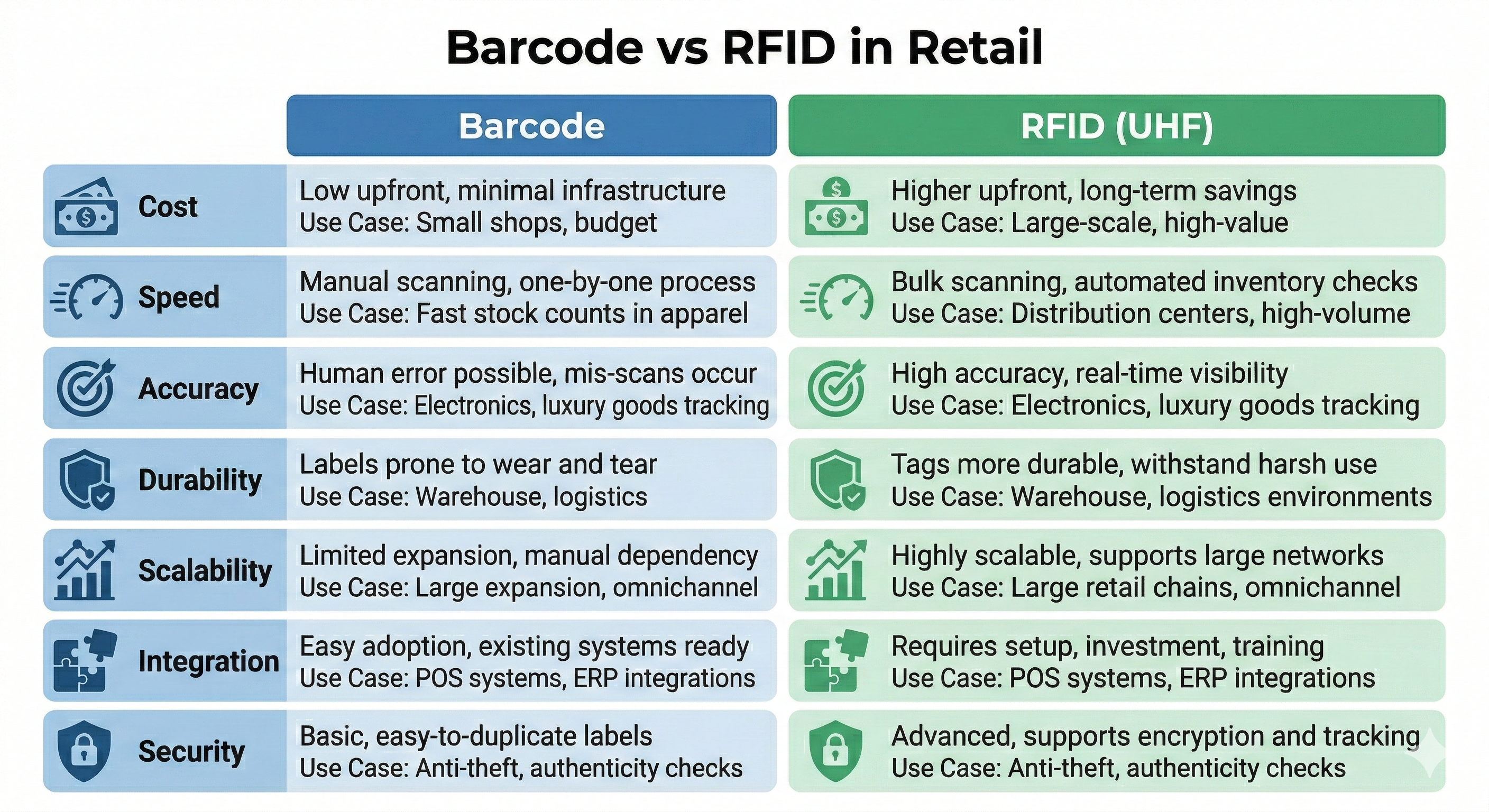
RFID vs Barcode: Side-by-Side Comparison
|
Factor |
Barcode |
RFID |
|
Cost |
Low upfront, minimal infrastructure. Affordable for small retailers. |
Higher upfront investment, but delivers long-term savings through efficiency and accuracy. |
|
Speed |
Manual scanning, one item at a time. Slows down bulk inventory checks. |
Bulk scanning, automated inventory updates. Saves hours during stock counts. |
|
Accuracy |
Human error is possible; mis-scans can occur. |
High accuracy with real-time visibility. Reduces shrinkage and improves reporting. |
|
Durability |
Labels are prone to wear and tear, especially in harsh environments. |
Tags are more durable and withstand repeated use, even in warehouses or logistics. |
|
Scalability |
Limited expansion, heavily dependent on manual processes. |
Highly scalable, supports large networks and complex inventory systems. |
|
Integration |
Easy adoption with existing systems. Works well with POS and ERP setups. |
Requires setup investment and staff training, but integrates seamlessly once implemented. |
|
Security |
Basic, easy-to-duplicate labels. |
Advanced, supports encryption and item-level tracking. |
|
Data Capacity |
Stores limited product information. |
Can store more detailed data on each tag. |
|
Customer Experience |
Quick checkout, familiar process for shoppers. |
Faster stock availability supports omnichannel fulfillment and better service. |
Real-World Retail Use Cases
Fashion & Apparel
Barcodes have long supported product labeling and checkout, but RFID takes inventory management to another level. Retailers can perform full stock counts in minutes instead of hours, ensuring shelves are replenished quickly and customers find what they need.
Grocery & FMCG
Barcodes remain highly effective for quick checkout and low-cost labeling in fast-moving consumer goods. However, RFID is increasingly being explored for tracking expiration dates, improving supply chain visibility, and reducing waste—especially in fresh produce and perishable items.
Luxury & Electronics
Barcodes provide basic product identification, but they can be easily duplicated. RFID offers stronger protection by enabling item-level tracking, helping retailers prevent theft and verify authenticity—critical in high-value categories like jewelry, watches, and electronics.
Omnichannel Retail
Barcodes support traditional in-store operations, but RFID enables real-time visibility across channels. Retailers can sync online and offline inventory seamlessly, making “buy online, pick up in store” or same-day delivery more reliable.
Pharmaceuticals & Healthcare Retail
Barcodes are widely used for labeling medicines and medical supplies. RFID, however, adds greater value by ensuring precise tracking of sensitive products, monitoring storage conditions, and reducing errors in dispensing—vital for patient safety and compliance.
Home Improvement & Furniture
Barcodes help with basic product identification, but RFID provides deeper benefits in managing bulky or high-value items. Retailers can track stock across warehouses and showrooms, streamline logistics, and improve customer service by knowing exactly where each item is located.
Retailer Takeaway
Barcodes remain cost-effective and practical for everyday retail tasks, especially in smaller stores or low-margin categories. But RFID consistently delivers greater accuracy, efficiency, and security, making it the stronger choice for industries with complex inventories, high-value products, or omnichannel demands.
Future of Retail Tracking
The future points toward hybrid models where barcodes and RFID coexist. As RFID costs decline, adoption is expected to rise, especially in industries that demand automation, real-time visibility, and precise tracking—such as fashion, electronics, and pharmaceuticals—which are already leading the way in RFID adoption. As retailers integrate RFID with AI-driven analytics and smart retail systems, they can unlock deeper insights into customer behavior, optimize supply chains, and deliver seamless omnichannel experiences. In this way, RFID is not just a tool for inventory—it is becoming a driver of innovation in modern retail.
Conclusion
There is no single solution that fits every retailer. Barcodes remain a reliable, low-cost option for small-scale operations and businesses with straightforward inventory needs. They are easy to implement and universally recognized.
RFID, however, offers transformative benefits for retailers looking to scale, improve accuracy, and deliver better customer experiences. While the initial investment is higher, the long-term gains in efficiency, visibility, and security make RFID a powerful choice for future-focused businesses.
Recent Posts
-
How RFID Solves Shopify Inventory Challenges for D2C Brands
Shopify has quickly become the preferred platform for Direct-to-Consumer (D2C) brands. Its flexibili …Mar 16th 2026 -
RFID vs Barcode in Retail: A Side-by-Side Comparison
Introduction Retail is transforming at a rapid pace, and at the center of this change lies inventory …Mar 6th 2026 -
What Is an RFID Self-Checkout System? A Complete Guide for Retailers
Introduction Retail checkout has seen a remarkable transformation over the years. What started with …Feb 27th 2026