
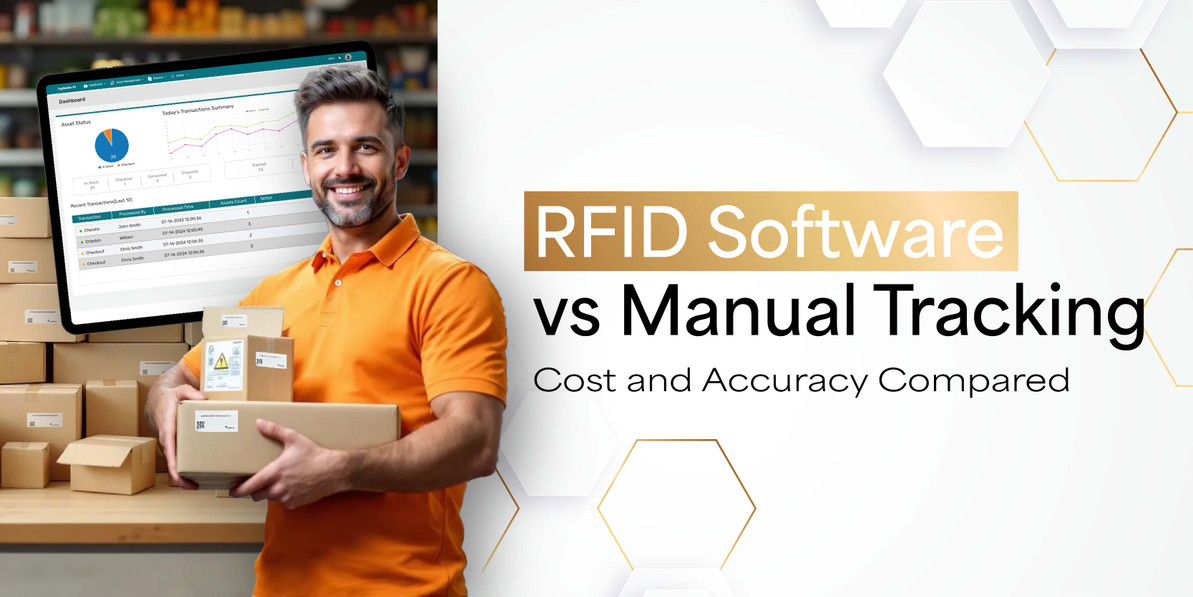
RFID Software vs Manual Tracking — Cost and Accuracy Compared
Inventory and asset tracking are the backbone of efficient operations in logistics, retail, and manufacturing. Yet many businesses still rely on outdated manual methods that are prone to errors and delays. As supply chains grow more complex, cost control and data accuracy have become non-negotiable.
This blog compares RFID software and manual tracking systems to help decision-makers evaluate which solution best fits their operational needs and long-term goals.
Understanding the Basics
What Is Manual Tracking?
Manual tracking involves human-driven processes like:
- Spreadsheets for inventory counts
- Barcode scanning with handheld devices
- Paper logs for asset movement
These methods are common in small businesses or legacy systems where automation hasn’t been adopted. While simple to implement, they are labor-intensive and error-prone.
What Is RFID Software?
RFID software automates inventory and asset tracking using RFID tags, readers, middleware, and dashboards. It enables real-time, contactless data capture, minimizing manual effort and errors. Businesses gain faster visibility, improved accuracy, and streamlined operations across logistics, retail, and manufacturing environments.
Cost Comparison
|
Cost Category |
Manual Tracking |
RFID Software |
|
Initial Setup Costs |
Low hardware cost (clipboards, scanners, spreadsheets); staff training required |
A little bit higher upfront cost (tags, readers, software); integration needed, but prices are declining |
|
Operational Costs |
High labour cost; manual entry, audits, and corrections; workflow delays |
Lower labor dependency; periodic maintenance, software updates, minimal retraining |
|
Error Correction Costs |
Frequent manual reconciliation is time-consuming and costly |
Automated error detection; minimal correction effort |
|
Shrinkage & Loss |
Prone to miscounts and theft; hard to detect until late |
Reduced shrinkage; real-time alerts and traceability |
|
Productivity Impact |
Slower processes; bottlenecks due to manual steps |
Faster operations; streamlined workflows |
|
Scalability Costs |
Costs rise with volume; more staff and time are needed |
Scales efficiently; minimal cost increase with growth |
|
Long-Term ROI |
Limited; savings offset by recurring inefficiencies |
Strong ROI; faster inventory turns and fewer stockouts |
|
Compliance Readiness |
Manual reporting; time-intensive |
Built-in reporting and audit trails |
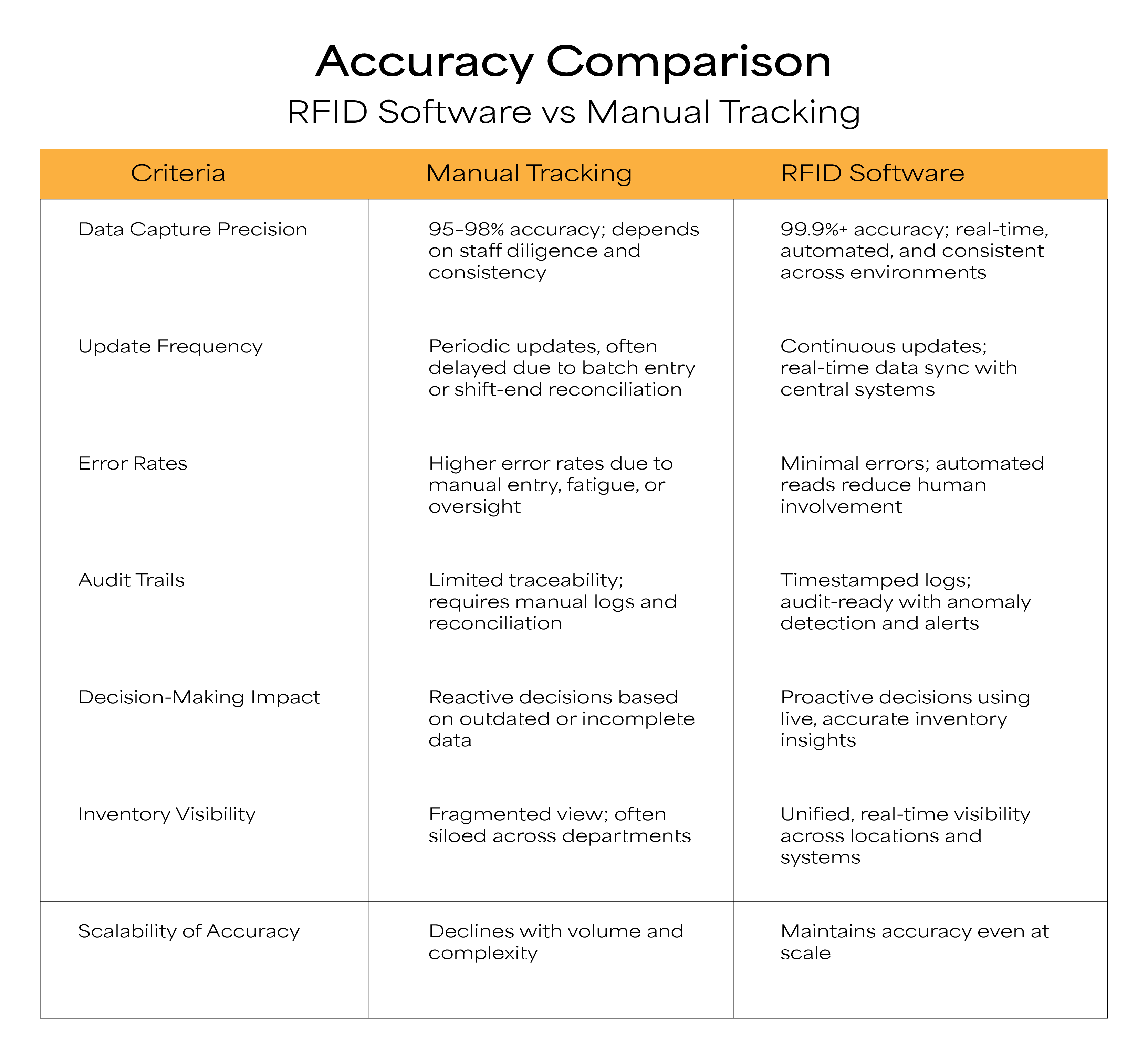
Accuracy Comparison
|
Criteria |
Manual Tracking |
RFID Software |
|
Data Capture Precision |
95–98% accuracy; depends on staff diligence and consistency |
99.9%+ accuracy; real-time, automated, and consistent across environments |
|
Update Frequency |
Periodic updates; often delayed due to batch entry or shift-end reconciliation |
Continuous updates; real-time data sync with central systems |
|
Error Rates |
Higher error rates due to manual entry, fatigue, or oversight |
Minimal errors; automated reads reduce human involvement |
|
Audit Trails |
Limited traceability; requires manual logs and reconciliation |
Timestamped logs; audit-ready with anomaly detection and alerts |
|
Decision-Making Impact |
Reactive decisions based on outdated or incomplete data |
Proactive decisions using live, accurate inventory insights |
|
Inventory Visibility |
Fragmented view; often siloed across departments |
Unified, real-time visibility across locations and systems |
|
Scalability of Accuracy |
Declines with volume and complexity |
Maintains accuracy even at scale |
Use Case Scenarios
Retail
RFID Software:
- Enables self-checkout by automatically detecting tagged items, reducing wait times and labor dependency.
- Supports real-time shelf monitoring, helping staff restock faster and avoid out-of-stock situations.
- Facilitates loss prevention by tracking item movement and triggering alerts for unauthorized exits.
- Integrates with POS and inventory systems, ensuring accurate sales and stock data without manual reconciliation.
Manual Tracking:
- Requires staff intervention for scanning each item, slowing down checkout and increasing labor costs.
- Shelf audits are periodic and manual, often missing real-time stockouts or misplaced items.
- Theft detection is reactive, relying on CCTV or manual checks.
- Inventory updates lag behind actual sales, leading to stock discrepancies.
Warehousing
RFID Software:
- Automates inbound and outbound tracking, logging item movement as it passes through dock doors or zones.
- Supports location-based tracking, allowing operators to find items instantly within the warehouse.
- Enhances cycle counting by enabling fast, non-intrusive scans without halting operations.
- Integrates with WMS and ERP systems, improving order accuracy and fulfilment speed.
Manual Tracking:
- Relies on paper logs or barcode scans, which are time-consuming and prone to transcription errors.
- Item location is often manually recorded, making retrieval slower and less reliable.
- Cycle counts require physical handling and downtime, disrupting workflows.
- Data entry errors can lead to mispicks, delayed shipments, and customer dissatisfaction.
Manufacturing
RFID Software:
- Tracks components and assemblies through each stage of production, enabling real-time visibility.
- Supports automated quality checks by logging timestamps and process data at each station.
- Enables traceability for compliance and recalls, linking finished goods to raw material batches.
- Reduces downtime by identifying bottlenecks and optimizing throughput.
Manual Tracking:
- Struggles with batch-level visibility, especially in multi-stage or high-volume environments.
- Quality control relies on manual logs, which are harder to audit and prone to omissions.
- Traceability is limited, making recalls and root cause analysis more difficult.
- Production data is often delayed or incomplete, affecting planning and efficiency.
Scalability and Integration
Manual tracking systems are hard to scale, often siloed and reliant on manual syncing across departments. In contrast, RFID software integrates seamlessly with ERP, WMS, and analytics platforms, enabling centralized control and supporting multi-site operations with consistent data flow and automation.
ROI and Business Impact
RFID systems typically achieve ROI within 12–24 months, driven by reduced labor costs, lower shrinkage, and faster cycle counts. Enhanced inventory accuracy leads to better stock availability and improved customer satisfaction. In competitive industries, RFID adoption strengthens operational agility and positions businesses for scalable growth.
Conclusion
Manual tracking may still be viable for very small operations with limited inventory. However, for growing businesses, RFID software offers unmatched accuracy, speed, and long-term value. As costs continue to fall, RFID is becoming the new standard for modern inventory and asset management.
Frequently Asked Questions (FAQs)
What is manual tracking in inventory and asset management?
Manual tracking involves human-driven processes such as spreadsheets, barcode scanning with handheld devices, and paper logs. While simple, it is labor-intensive and prone to errors.
What is RFID software in inventory management?
RFID software automates tracking using RFID tags, readers, middleware, and dashboards, enabling real-time, contactless data capture with minimal manual effort.
How do setup costs compare between manual tracking and RFID software?
Manual tracking has low upfront costs but requires ongoing labor. RFID software has higher initial costs (tags, readers, integration) but prices are declining and ROI is stronger long term.
Which system has higher operational costs?
Manual tracking incurs high labor costs, frequent audits, and workflow delays, while RFID software reduces labor dependency and requires only periodic maintenance and updates.
What impact does each system have on error correction?
Manual tracking requires time-consuming reconciliations. RFID software offers automated error detection, minimizing correction efforts.
How do both systems affect productivity?
Manual tracking slows processes and creates bottlenecks. RFID software enables faster operations, streamlined workflows, and proactive decision-making.
Which system is more scalable?
Manual tracking struggles as volume grows, requiring more staff and time. RFID software scales efficiently, maintaining accuracy and minimizing cost increases.
What is the overall ROI difference between manual tracking and RFID software?
Manual tracking offers limited ROI due to recurring inefficiencies. RFID software typically achieves ROI within 12–24 months, driven by reduced labor costs, lower shrinkage, and faster cycle counts.
Recent Posts
-
How RFID Solves Shopify Inventory Challenges for D2C Brands
Shopify has quickly become the preferred platform for Direct-to-Consumer (D2C) brands. Its flexibili …Mar 16th 2026 -

RFID vs Barcode in Retail: A Side-by-Side Comparison
Introduction Retail is transforming at a rapid pace, and at the center of this change lies inventory …Mar 6th 2026 -
What Is an RFID Self-Checkout System? A Complete Guide for Retailers
Introduction Retail checkout has seen a remarkable transformation over the years. What started with …Feb 27th 2026